
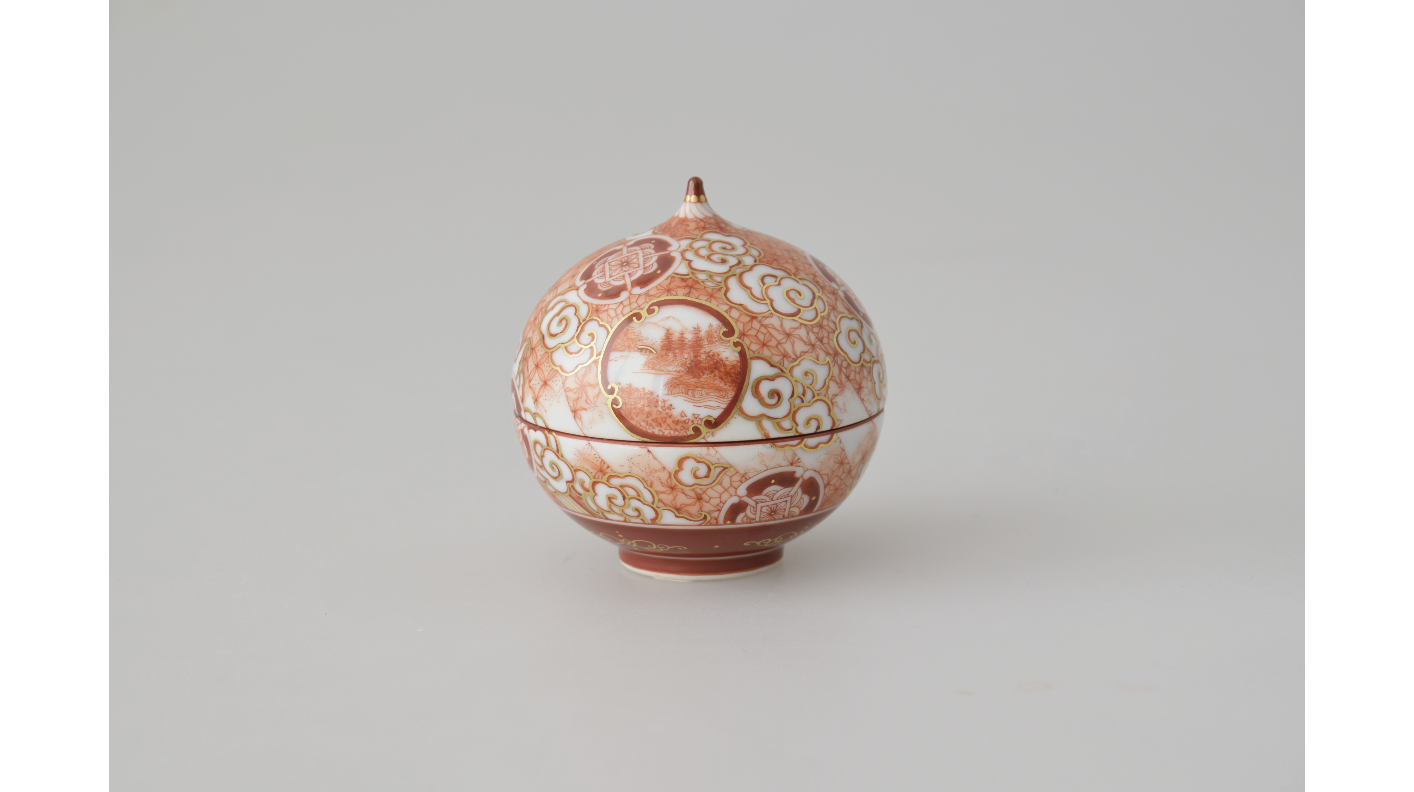
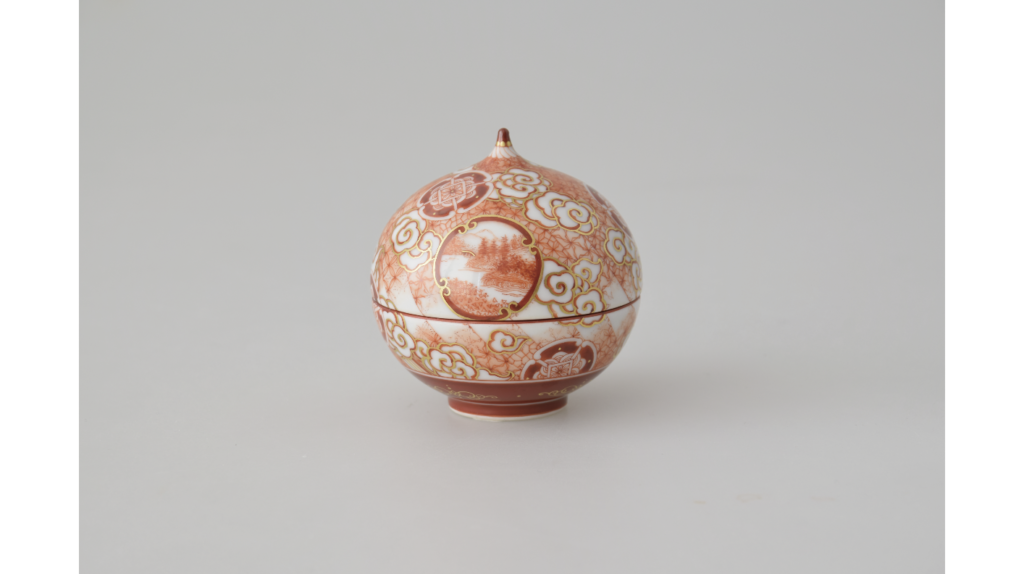
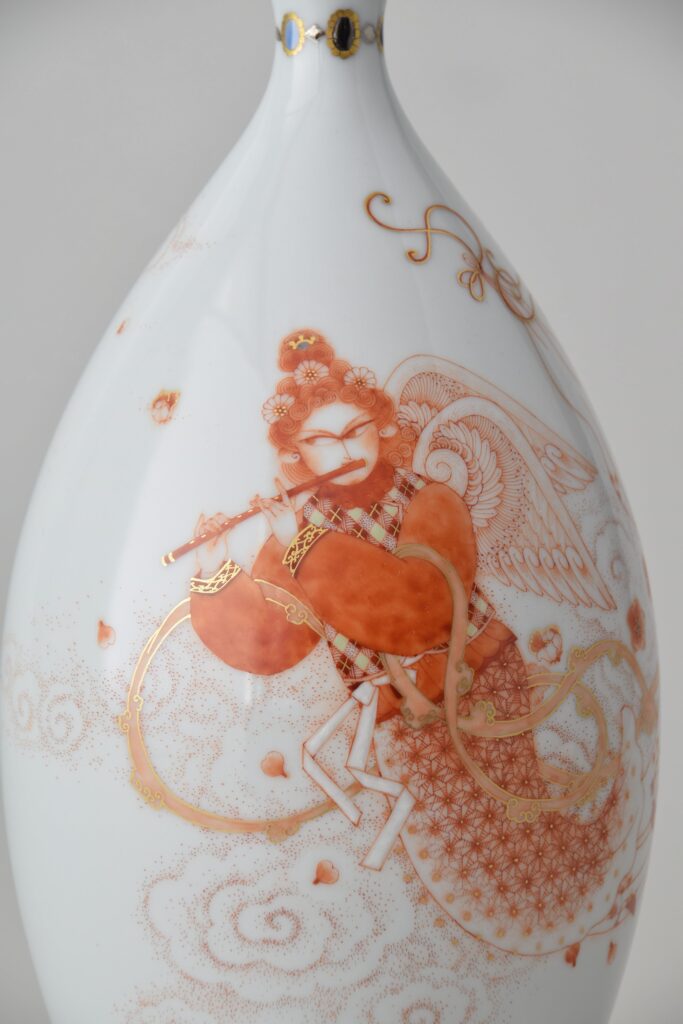
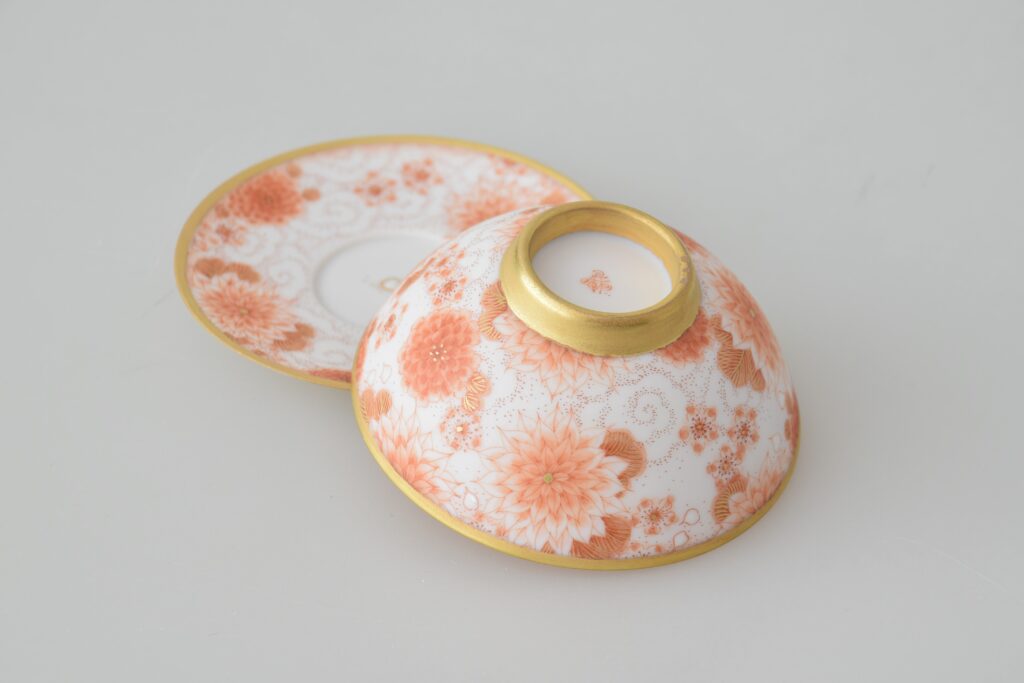
Mako Nakatani is a ceramic painter who pursues her own unique style whilst upholding the traditional Kutani-yaki technique known as ‘Akae-Sodai’. Using gradations of red that seem to blend into the white porcelain, alongside delicate line work, she depicts motifs such as angels, mermaids and light filtering through the forest, imbuing her work with a rich narrative quality. From her student days in Hokkaido to her fateful encounter with Kutani ware, and on to the creative philosophy nurtured between tradition and individuality―we trace the journey of this young artist, who is set to lead the next generation of Kutani ware, and the source of her artistic expression.
―I understand you are originally from Hokkaido, Ms Nakatani. Could you tell us what first drew you to Kutani ware?
It all began with a photograph of a sakazuki (sake cup) featuring fine red-painted designs that I saw in a magazine when I was in junior high or high school. I was deeply captivated by the beauty of the hemp-leaf patterns and komon designs depicted on it. Back then, I had the impression that such patterns were old-fashioned, the sort used on kimonos in period dramas. But that sakazuki looked very modern, and I thought it was ‘cool’. I was amazed that such a beautiful pattern could be created simply from a succession of geometric straight lines and circles. I even bought a slightly upmarket red cap-top pen in my favourite shade and tried my hand at drawing komon patterns by imitating what I’d seen. However, it wasn’t until more than ten years later that I actually got to hold a piece of Kutani ware in my hands. I visited Ishikawa Prefecture after graduating from university and was able to see the real thing for the first time.
―Could you tell us what prompted you to pursue a career in ceramics?
After graduating from university, I worked for a year at a private company. Behind the office was a shop selling handcrafted arts and crafts, and I often popped in there during my lunch break. The shopkeeper would talk to me at length not only about the pieces themselves, but also about the makers’ intentions, their working environments and the materials used. As I listened to these stories, the desire to ‘try making things myself’ began to take root. After that, I left the company and spent about two years working odd jobs. I was working as a live-in part-time worker on a farm in Furano, Hokkaido, whilst my friends from university were gaining experience as new graduates and beginning to take on roles mentoring their juniors. Meanwhile, I couldn’t put my sketchbook down even during breaks from farm work, and my daily routine involved going out to sketch flowers during my lunch breaks. Watching those around me gradually build their careers made me think more and more about my own future. When I asked myself what I really wanted to do, I realised, ‘My starting point was that tamagahai I saw back in my student days.’ I thought that if I was going to regret it, I might as well give it a go one last time. With that in mind, during the winter of my second year as a part-timer, I travelled alone to Ishikawa Prefecture.
―Did you intend to enrol at the Kutani Ware Technical Training Centre straight away?
First of all, I wanted to see authentic Kutani ware, so I boarded a sightseeing bus touring the tourist spots in Kaga. The route included ‘Kutani Bitoen’. I popped in on a whim, and there I had an unexpected encounter. As it happened, the shop assistant was from the same hometown as me. When I told them, ‘I’ve come to visit the training centre because I want to learn Kutani ware red-painted decoration’, they asked, ‘I’m planning to visit some pottery studios now―would you like to come along?’ Thanks to that, I was able to go on a tour of the pottery workshops, which hadn’t been part of my original plan. What’s more, they contacted Mr Takayama Fukushima―a leading expert in Ak-e fine-line painting in Nomi City―and arranged for me to visit his studio.
―What was your first impression when you saw Ak-e fine-line painting for the first time?
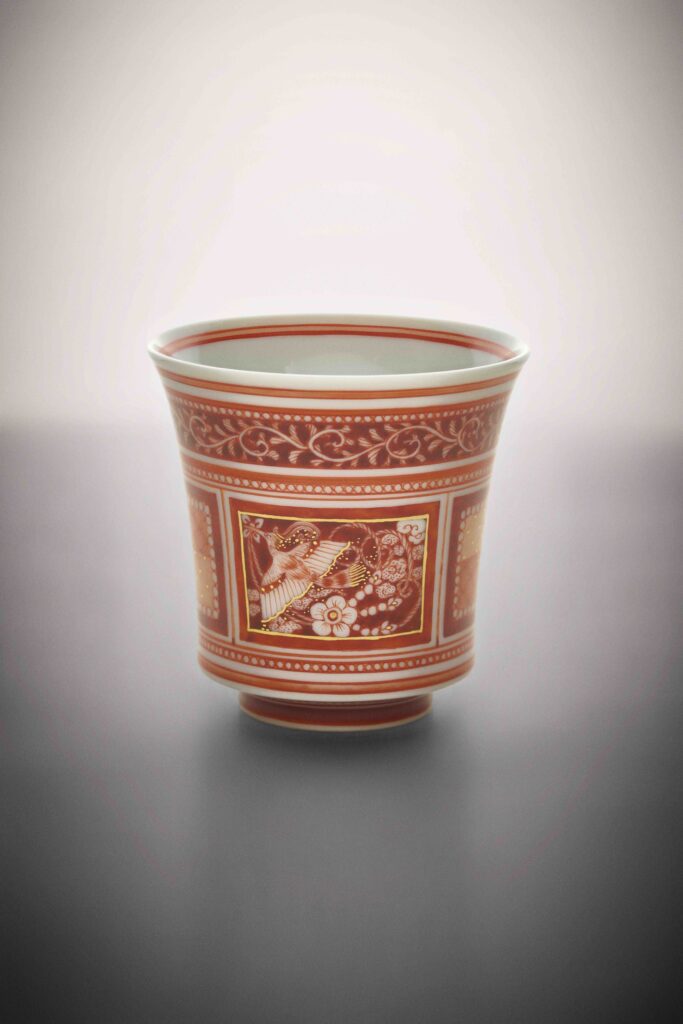
When I actually held it in my hands, I felt as though I’d shrunk to the size of a little person. You can’t tell just by looking at photographs, but the patterns are incredibly dense. They’re so fine that, when viewed from a slight distance, they appear to be a soft pink. I felt that this visual effect was another charm unique to Akae-sobori. It was a constant series of surprises. There was a sense of power and delicacy that photographs simply cannot convey, and I remember being deeply moved, thinking, ‘This is the real thing.’
― Is there anything else you pay particular attention to, apart from the negative space?
In pieces such as sake cups, I sometimes deliberately use a technique where I fill in a section with red. I personally love this technique very much. However, some customers feel that it simply looks as though I’ve ‘just filled it in’ without drawing any patterns or designs. That is precisely why I want to ensure that the red section has a sense of conviction―so that it is clear this is not merely a shortcut, but that there is a deliberate intention behind the red filling.
――What inspires you outside of your creative work?
Rather than learning from the world of ceramics itself, I tend to draw inspiration from other fields more often. For example, an acquaintance from my secondary school days was a member of the debating society; he has now turned debating into a business and published a book. In that book, there was a passage stating that ‘by deliberately creating “pauses” in a speech, the message you wish to convey becomes clearer’. When I read that, I realised it was exactly the same as when I’m creating my work. It is precisely because there is white space that the subject stands out. When I hit a creative block, I try to look as far away from pottery as possible.
―Could you tell us about a piece of your own work that has left a particularly strong impression on you?
I didn’t grow up surrounded by traditional Japanese styles or culture from a young age. On the other hand, I was familiar with scenes that evoked Western culture, such as the Trappist Monastery in Hakodate and the Clark Statue in Sapporo. About two or three years after I started working with Aka-e, I decided to incorporate my own roots into my work and took the plunge to try painting an angel. Following on from that, I also began creating pieces inspired by the world of picture books, such as mermaids.
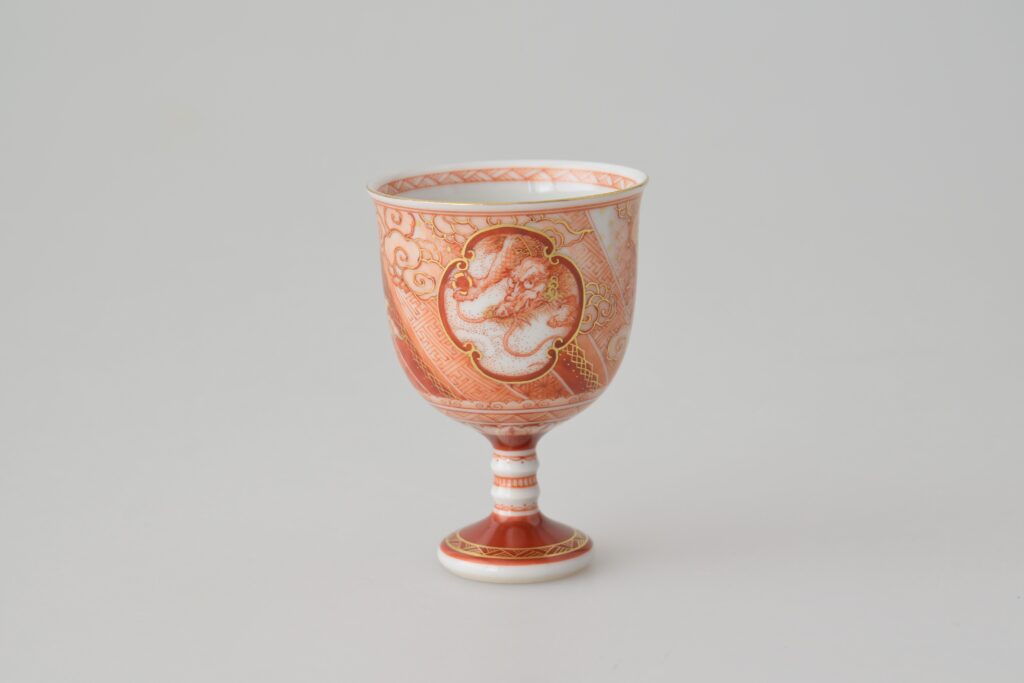
―The angels and mermaids painted in soft reds really feel like a style unique to you, Ms Nakatani. When did you start entering craft exhibitions?
My first submission was to the 2023 Kutani-yaki Traditional Crafts Exhibition. Part of me wanted to try something new. I also hoped that by placing my work in a different environment and viewing it alongside other pieces, I might gain new perspectives and insights that could only be discovered through comparison. After that, an acquaintance suggested, ‘Why not try entering the Japan Traditional Crafts Exhibition?’, and so I began submitting my work to nationwide open-entry exhibitions.
――You won the Newcomer’s Award at the 2023 Kutani Ware Traditional Crafts Exhibition and were selected for the Japan Traditional Crafts Exhibition in the same year. How did such recognition affect you?
The piece that won the Newcomer’s Award at the Kutani Ware Traditional Crafts Exhibition featured an angel motif. Up until then, I’d been anxious, wondering, ‘Will the motif of an angel be accepted in the world of traditional crafts?’ But actually receiving that recognition made me feel as though the preconceptions I’d arbitrarily imposed on myself had been dispelled somewhat. On the other hand, looking back now, I think being selected for the Japan Traditional Crafts Exhibition was perhaps just beginner’s luck. Still, that experience was truly significant. At the exhibition venue, it’s inevitable that you tend to notice only your shortcomings and areas for improvement. However, it was precisely because of that experience that I was able to recognise challenges and possibilities I hadn’t seen before.
― Did you used to feel apprehensive about taking on new challenges?
I did, actually. I had an idealised image of myself, and I felt that taking on a challenge would reveal the gap between that and my actual self. But once you understand just how big that gap is, you can see what you need to do next, can’t you? So now, I believe there’s nothing to lose by taking on a challenge. I’ve come to realise that, whatever the outcome, there’s always something to be gained for me personally.
― Is there anything you’d like to try in the future?
In the future, I’d like to have my work displayed in places such as hotels in Niseko, Hokkaido. As Niseko attracts many visitors from overseas, I’d be delighted if I could create opportunities for my work to be seen by them. I hope that Hokkaido, where I’m from, and Kutani ware, which I’m currently working on, can be connected in some way.
― Are you actually seeing more opportunities for overseas customers to purchase your work?
Thankfully, it’s gradually increasing. When I held an exhibition at a gallery in Kanazawa’s Higashi Chaya District this past February, a Brazilian woman in her twenties or thirties came to see my work. She purchased a decorative plate, about 30 cm in diameter, featuring a mermaid. When I spoke to her afterwards, she told me she’d been drawn to the mermaid’s expression. It made me very happy that she could relate to a motif that is so personal to me.
― As you’ve continued with your pottery, have your values changed?
I think my values have changed significantly. When I first started pottery, I believed that ‘creating works with confidence’ was what mattered most. However, over the past year or two, my way of thinking has shifted. Now, I’ve come to prioritise ‘trusting my own instincts above all else until a piece is finished’. When I look around, there are far too many people who either have natural talent or are constantly honing theirs, and to be honest, that makes me feel sad; there are many times when I lose confidence in my own work. But through my creative process, I’ve come to realise that unless I trust my own instincts, my work will never be truly finished. And once a piece is properly completed, I’ve found that my focus shifts away from the noise of others and towards the new challenges I’ve discovered within myself, or the next things I want to try. I want to keep working, trusting my instincts, until the piece is finished. That feeling has grown stronger within me.
―So, what sort of artist would you like to be in ten years’ time?
I am surrounded by senior artists I respect, ranging from their thirties to their eighties. Yet, when I imagine myself ten years from now, I think, ‘I’ll probably never be like any of them.’ That’s because each of them possesses a unique and irreplaceable form of expression. That is precisely why, over the next ten years, what I want to prioritise is being able to clearly articulate the core of my own artistic expression. Why am I creating this piece? What do I value most? I want to be able to organise these thoughts within myself and carefully translate them into tangible form.
PROFILE
Kutani ware artist
Mako Nakaya
Born in Hokkaido. Graduated from the Ishikawa Prefectural Kutani Ware Technical Training Centre in 2021. Studied red-painted fine line work and established her own studio in 2024. Building on the foundation of traditional red-painted fine-line decoration, she pursues a unique style that makes the most of delicate patterns and negative space, whilst incorporating motifs from other cultures, such as angels and mermaids. In 2023, she won the Newcomer Award at the Kutani Ware Traditional Crafts Exhibition and was selected for the first time for the 70th Japan Traditional Crafts Exhibition. In 2024, she was selected for the 71st Japan Traditional Crafts Exhibition.