
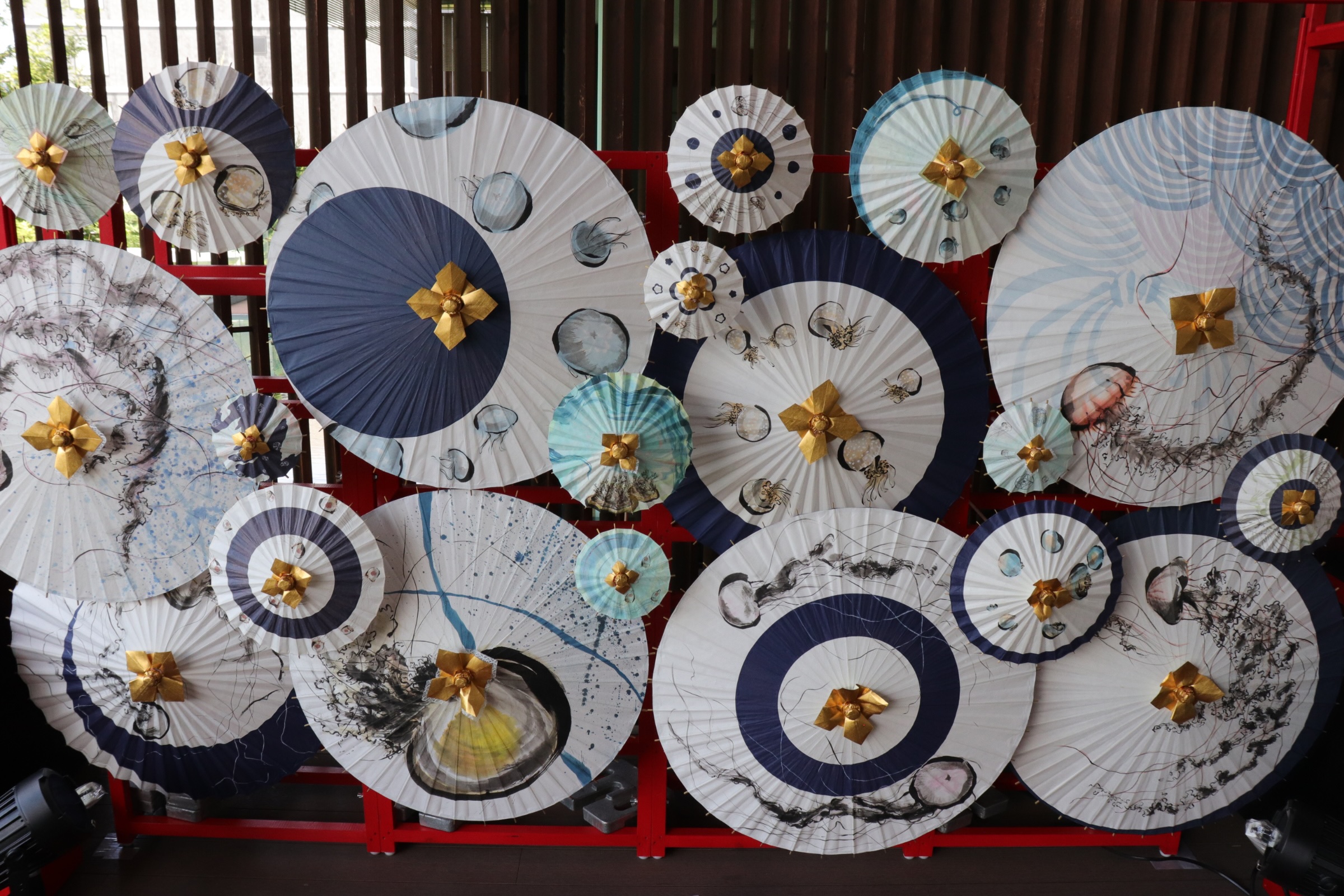
In Kyoto, the thousand-year-old capital, a single Japanese umbrella stands quietly. Within it dwells over a century of artisan craftsmanship and the resolve to pioneer the next era. Kōtarō Nishibori, fifth-generation head of the venerable Hiyoshiya, has evolved the Kyoto Japanese umbrella―once facing decline―into lighting and spatial design, demonstrating new possibilities for traditional craftsmanship. His values were shaped by encounters with different cultures in his native Wakayama and by re-examining Japan while abroad. ‘Tradition is not something to be preserved; it thrives through the accumulation of innovation.’ Nishibori’s words resonate with the pride of a craftsman who continually challenges the changing times. From the origins of the Japanese umbrella to lighting, and then to nurturing the next generation of artisans. We wish to shine a light on the trajectory of this challenge.
Q: I understand you are originally from Shingū City in Wakayama Prefecture. What shaped your values before entering the world of Japanese umbrellas?
Shingū City, where I grew up, is a regional town at the southern tip of the Kii Peninsula. It’s said to be the birthplace of Aikido, and I began practising it myself in junior high school. The dojo had many foreign students; it was a very unique environment where nearly half the members were non-Japanese. Furthermore, my family ran an English language school, and foreigners would come for homestays, so I had many opportunities to encounter foreign cultures from childhood.
Q: How did interacting with foreign individuals influence your thinking about your future path?
My student years coincided with the period just as the bubble economy was ending, or perhaps just before it ended, when the “examination war” was at its peak. The prevailing narrative was that happiness lay in getting into a good university and then a good company. However, commuting to the dojo morning and evening, I encountered foreigners living by values entirely different from those of economic success. Among them were university professors, musicians, and even someone who had been a bodyguard for a former US president. Each was dedicated to martial arts training based on their own convictions. Interacting repeatedly with these people, whose way of life was the polar opposite of the “correct answers” taught at school, made me start wondering, “What truly is the right way to live?” These experiences naturally sparked a growing interest in going overseas. After graduating high school, I decided to take the plunge and go to Canada on a working holiday. After a year’s stay, I returned home, but I simply had to go back to that place to learn more, so I headed back to Canada. In total, I stayed for about two years.
Q: How did your awareness of Japan change after going abroad?
Only after leaving Japan did I become intensely conscious of “Japanese culture” and of “being Japanese”. It was a profoundly shocking experience for my younger self, and it undoubtedly laid the foundation for later taking over the traditional Japanese umbrella shop.
Q: After returning, I understand you took a job at the city council.
I had met a Croatian friend during my working holiday and we planned to ‘open a sushi restaurant in Croatia’. To save funds for that, I took a job at my local Shingu City Council. The mayor at the time was actively promoting sister city initiatives and sought someone who could speak English. I was assigned to the Economic and Tourism Division, where I handled interpreting, translation, and接待 for overseas guests. It was while working at the city hall and saving money that I met my current wife. Her family home was Hiyoshiya, a long-established Kyoto Japanese umbrella shop with over 100 years of history.
Q: What was your impression when you first saw a Japanese umbrella?
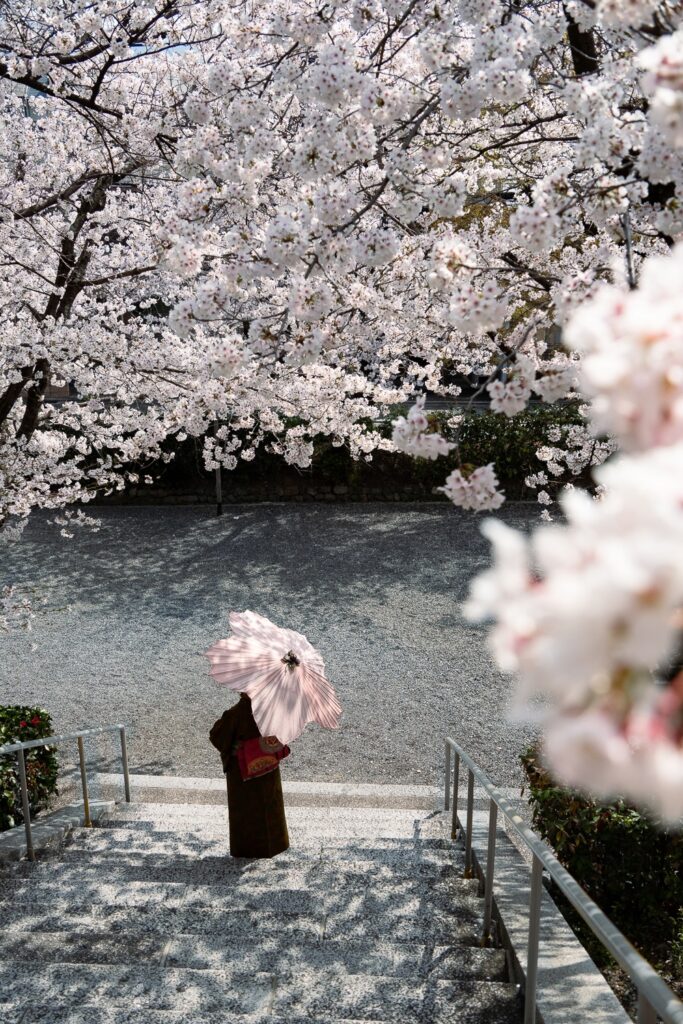
I saw a Japanese umbrella for the first time when visiting my wife’s family home. Having developed an interest in Japanese culture and history from my time in Canada, I honestly thought they were “subtly stylish”. A feature article in a magazine displayed at the shopfront also made an impression. It showed photographs of the tea ceremony held during Queen Elizabeth II’s visit to Japan, and I learned that the red no-dachi umbrella used was crafted by Hiyoshiya’s third-generation master. The fact that they made something used to welcome a state guest made me think, ‘This is incredible.’ However, Hiyoshiya was in a dire situation at that time. My wife’s mother, the fourth-generation owner, said, ‘We can’t sell anymore, so we’re quitting.’ Annual sales were around ¥1.6 million. My wife’s sisters had no intention of taking over either, and the business was on the brink of closure.
Q: Witnessing this critical situation, did you immediately resolve to take over?
At the time, I was still a civil servant, so the idea of taking over immediately didn’t occur to me. Upon hearing the details, I learned that only two traditional Japanese umbrella shops remained in Kyoto. By the time I took over, Hiyoshiya would be the last one. In other words, Hiyoshiya closing down meant the culture of Kyoto traditional umbrellas would cease to exist. Given this background, I began to think about how we might somehow keep it going.
Q: What was your first step?
Around that time, I was responsible for creating a website for the city’s tourism promotion. Windows 95 had just been released, and I sensed it would become a new, low-cost tool for communication even in regional areas. Drawing on that experience, I decided to create a website for Hiyoshiya too. With the help of my younger brother, who was a university student at the time, we completed it in 1997. Back then, shopping carts and credit card payments were difficult, so it was a simple mail-order system: photos and prices were listed, with the message “If you want one, email us”. Then, orders immediately came in from people involved in dance circles in Tokyo, and from there, orders kept pouring in. Riding the wave of the internet’s dawn, Hiyoshiya’s sales grew rapidly.
Q: When did you yourself begin to get seriously involved in making Japanese umbrellas?
Around the time sales started growing through the internet, I had the opportunity to learn the craft when visiting my wife’s family home. I borrowed tools, filmed the process, and tried to learn by imitation. Weekends meant driving to Kyoto, concentrating on lessons over Saturday and Sunday, then returning Monday morning. That became my routine.
Q: When you first started making Japanese umbrellas, which stage proved most challenging?
They say an umbrella has as many stages as it has ribs, but the most difficult is “torihari” – attaching the washi paper to the ribs. Natural bamboo ribs aren’t perfectly straight. Applying straight paper inevitably causes misalignment. You moisten the washi paper with a spray bottle to make it stretch and shrink, then correct the alignment while applying it in one go. If you shift the paper on the stiffened ribs, it leaves marks, ruining the expensive handmade washi paper. For a large umbrella with a 3-metre diameter, a mere 5-millimetre error can stretch to several centimetres around the circumference. It might look simple, but it’s a process demanding “the concentration and skill to get it right in one attempt”.
Q: It’s a process where technique is put to the test, with no room for retakes. I left my civil service job and took over Hiyoshiya at the age of 29, I believe.
In 2003, at 29, I resigned and became a full-time craftsman. Sales at the time were around ten million yen. However, since Japanese umbrellas are intrinsically linked to kimono culture, it was clear demand would decline alongside the shrinking number of people wearing traditional attire. Relying solely on kabuki and tea ceremony would lead nowhere. I was constantly thinking about the “next move”.
Q: That led to the “innovation” of lighting that utilised Japanese umbrella techniques, didn’t it?
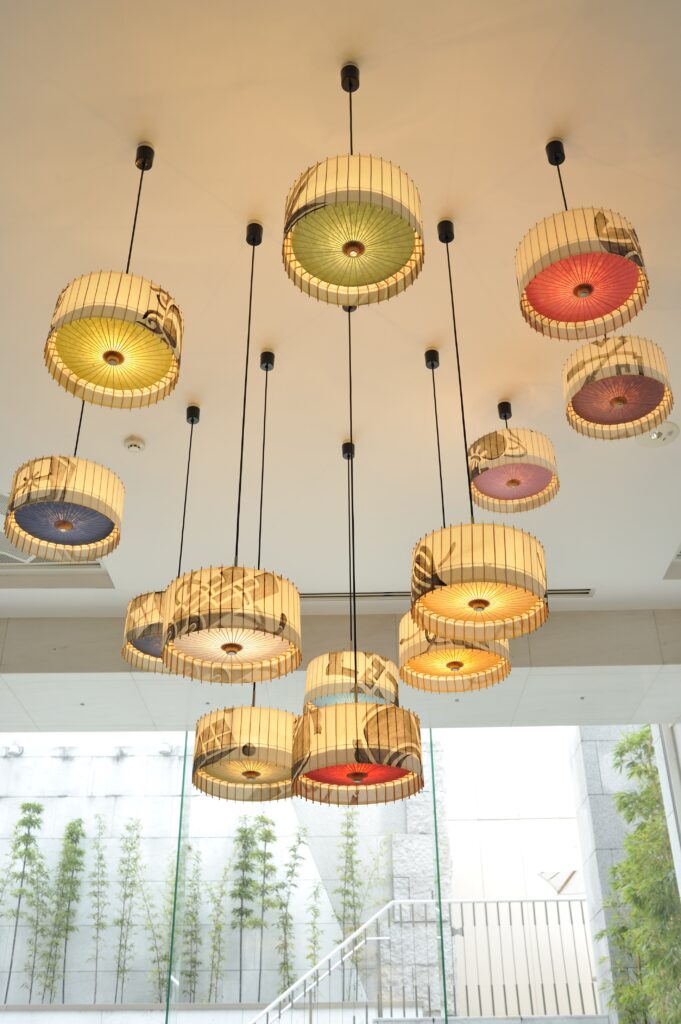
Yes. In 2004, I began developing an openable/closable lighting fixture that applied the structure of Japanese umbrellas and washi paper techniques. Then in 2006, under the theme “Tradition is a continuous process of innovation”, I launched the first lighting series, “KOTORI”. The following year, spurred by winning the Good Design Award, we entered the interior design industry.
Q: What sentiment lies behind the corporate philosophy ‘Tradition is a continuous process of innovation’?
I believe tradition is built upon layers of innovation. Tracing the history of umbrellas, we see that in the Nara period they served as ‘evil-warding charms’. Through technological innovations like opening/closing mechanisms and waterproofing, they became widespread as ‘rain gear’ by the Edo period. Past innovations have shaped today’s traditions. The lighting we created in 2006 may itself be called “tradition” decades from now. When that happens, the next innovation will be needed. What I convey to our staff is to cherish our origins in Japanese umbrellas while never fearing new challenges. We cannot sustain ourselves by continually producing items that don’t meet customer needs. Traditional crafts are fundamentally “products”, and I believe innovation adapted to the times is the path to connecting tradition to the future.
Q: Mr Nishibori, you’ve evolved Japanese umbrella techniques into lighting. Could you tell us about the construction of Kyoto Japanese umbrellas and the underlying aesthetic sensibility?
The characteristics of Kyoto Japanese umbrellas are best exemplified by the “Hon-shiki Nodegasa” (formal outdoor tea ceremony umbrella) commissioned by the Urasenke school of tea ceremony. This truly embodies the pursuit of colours and designs that harmonise with the spirit of wabi-cha. For instance, while larger traditional Japanese umbrellas typically increase the number of ribs for strength, the largest field tea ceremony umbrella deliberately reduces its rib count. Avoiding excessive ornamentation to pursue quiet beauty – this embodies the very philosophy of wabi-sabi. The “thread stitching” visible on the inside when the umbrella is open is also symbolic. Whilst Japanese umbrellas are said to have originally been introduced from China as Buddhist implements, Kyoto umbrellas are simple and restrained compared to their ornate Chinese counterparts. The very essence of the Kyoto umbrella lies in its sculptural beauty, refined over generations to reflect the intentions of successive masters, ensuring it blends seamlessly into the atmosphere of the tea room.
Q: What, in your own view, Mr Nishibori, is the unique charm of the Japanese umbrella?
Japanese umbrellas are coated with vegetable oil to achieve waterproofing. This process, called “oil application”, uses linseed oil at Hiyoshiya. After oiling, the umbrellas are dried in the sun. The sound the oiled paper makes when it rains – the patter-patter-patter as water beads off – is utterly charming and evocative. It possesses a unique sentimentality quite distinct from Western umbrellas.
Q: I understand the idea for the lighting came from this “sun-drying” process.
At Hiyoshiya, we borrow the grounds of the neighbouring Hōkyōji temple to sun-dry our umbrellas daily. Japanese umbrellas often feature bright colours like red to flatter the wearer’s complexion. They’re designed to reflect light, brightening one’s appearance even on gloomy, rainy days. One morning, while checking the dried umbrellas by holding them up to the light, I was struck by their beauty when illuminated by sunlight. ‘Wouldn’t this be beautiful if transformed into light from a bulb?’ I thought, and so began developing the lighting.
Q: I imagine trial and error followed from there. What was the initial design like?
The first design was inspired directly by the sight of sun-drying. It was a simple structure: just a bulb attached to a shade shaped like an umbrella. When exhibited at a trade show, visitors remarked, ‘That’s interesting,’ but unfortunately, it didn’t lead to orders. We were then introduced to a lighting designer, who proposed a cylindrical design. To us as umbrella makers, it felt like ‘this isn’t an umbrella’. However, when we hung it at an exhibition, the feedback from specialists like interior designers was overwhelmingly more positive for this cylindrical form. This moment made us keenly aware of the importance of market-in thinking (the market’s perspective) over product-out thinking (the maker’s perspective). I believe this experience – transcending our own assumptions and embracing an external perspective – was the first seed that would later blossom into success.
Q: Even after refining it into a cylindrical shape, maintaining the “openable structure” must have been challenging?
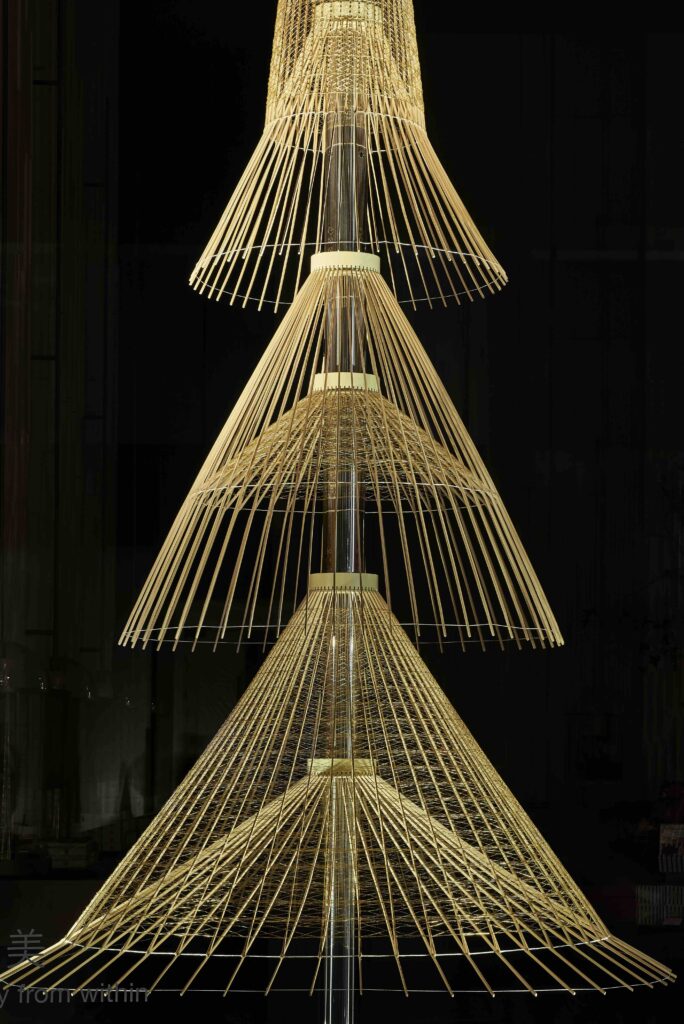
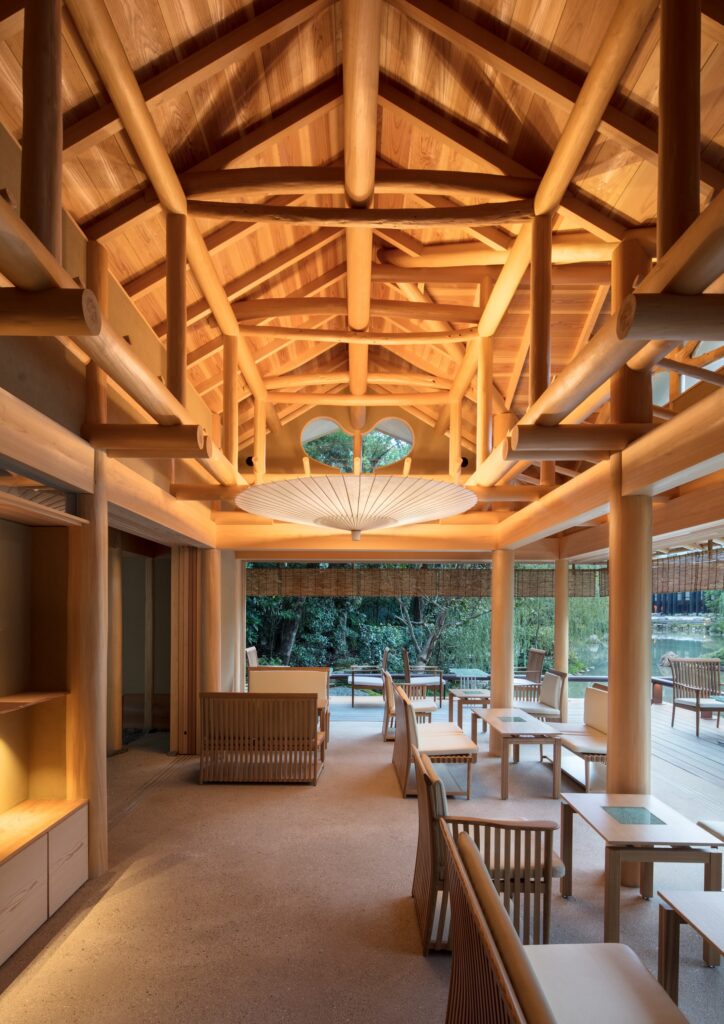
Preserving the “open” and “close” mechanism while keeping it aesthetically pleasing when open was truly difficult. We tried various solutions, like iron rings, but they either made assembly complex or resulted in a large package for what was supposed to be a foldable umbrella – nothing worked. Ultimately, we pursued a structure that minimised parts, allowed anyone to assemble it easily, and maintained the rounded form. The shape holds without fasteners because a central circular plate holds the horizontally opening bamboo ribs in place. We patented this groundbreaking structure, but it involved extensive trial and error. This simple structure we finally arrived at truly embodies “utility-based beauty”.
Q: Among the numerous collaborations you’ve undertaken, could you share a project that particularly stands out in your memory?
Each holds fond memories, but the most challenging were Yumi Katsura’s “Japanese Umbrella Dress” and “Japanese Umbrella Veil”. These required models to actually wear them and walk the runway, necessitating a structure where the human body became the umbrella shaft. Moreover, the designer’s request was: ‘Please use only natural materials like bamboo or wood, employing traditional techniques exclusively.’ Fashion designers’ rough sketches sometimes feature lines that are physically difficult to realise. Figuring out how to bring those to life was precisely where the craftsman’s skill came into play. We managed to complete production in time, but just before the Paris show, an accident occurred when the bamboo ribs broke as the model actually wore it… We rushed back to the hotel to fetch materials and repaired it backstage, working alongside other professionals. The sense of achievement when the show ended safely and the entire team exchanged applause remains unforgettable to this day.
Q: Please also tell us about the venture established in 2012, which later became ‘Hiyoshiya Craft Lab’.
The catalyst was when officials from Kyoto City Council, having learned of our successes in design development and overseas sales, approached us asking, ‘How can we expand overseas like Hiyoshiya?’ What I advised was to first clearly define the next target country, then involve that country’s culture and experts to co-create products. It’s what you might call “global localisation”. I believe it’s crucial to create items that resonate with the values and sensibilities of the people in that country. Based on this philosophy, we established a company called “TCI Laboratory” (later renamed “Hiyoshiya Craft Lab”) to expand support for overseas expansion beyond Kyoto traditional umbrellas to other traditional crafts.
Q: Could you elaborate on the specific form this support takes?
We’ve witnessed numerous instances where traditional crafts failed overseas when relying solely on a designer’s sensibilities. Therefore, we incorporate the perspective of buyers – overseas sales managers or agency presidents – before engaging designers. We invite them to Japan to learn pricing and sales methods suited to international markets, collaborating with artisans to create new products. For instance, when we showed a lacquerware piece to a French buyer, they remarked, ‘I don’t understand the appeal of lacquer,’ yet praised the technique, saying, ‘The skill to shave wood this thinly is remarkable.’ By reworking the product using that perspective, it eventually gained adoption by renowned European brands. To date, we have supported over 700 SMEs and traditional craft businesses, providing comprehensive assistance from “new product planning and development” through to “buyer-focused business meetings” and “exhibiting at domestic and international trade fairs”.
Q: What is the ultimate goal pursued by Hiyoshiya Craft Lab?
We are often asked, ‘Why not keep that know-how secret?’ But I want more people to realise just how truly impressive Japan’s traditional culture is. It’s not just about my own success; I want to increase the number of people across Japan who take pride in our traditional culture. For artisans collectively to open new markets and create work for the next generation. I believe our role is to foster that broader movement. Hiyoshiya can continue making Japanese umbrellas precisely because we’ve evolved them into new forms, like lighting. This development fosters the training of artisans, which in turn helps preserve tradition. And these innovations become the next “tradition”. I hope this cycle can be nurtured not just by us, but by the entire industry.
PROFILE
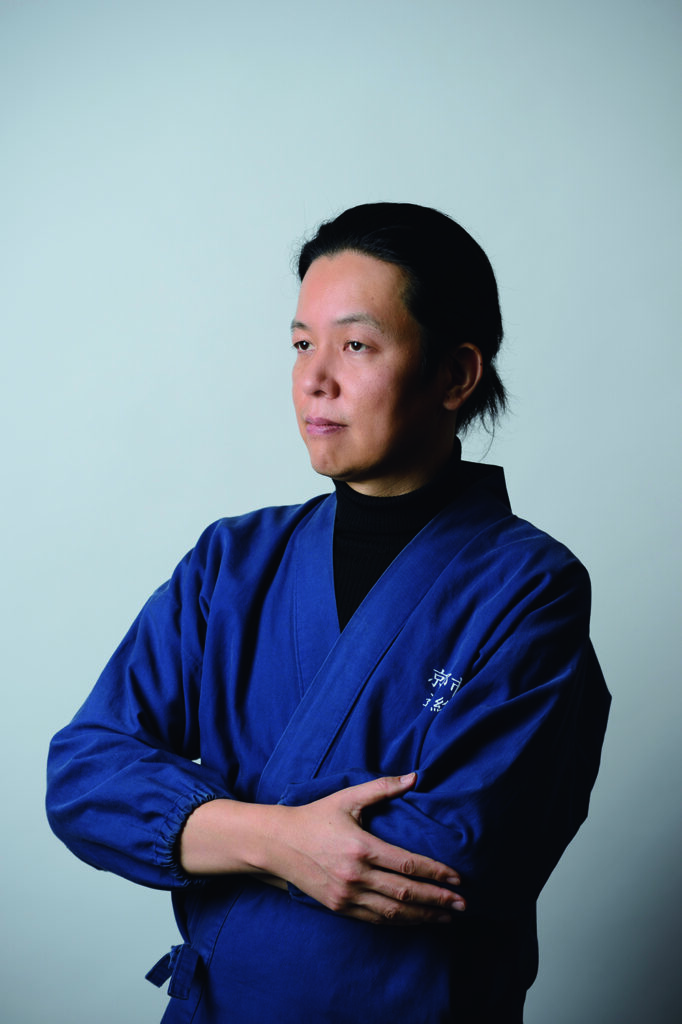
Kotaro Nishibori
Fifth-generation proprietor of Hiyoshiya, traditional craft “Kyō-Wagasa”
The sole manufacturer of Kyō-Wagasa, Hiyoshiya’s fifth-generation head. Born in Shingū City, Wakayama Prefecture. After studying in Canada, he worked as an interpreter at the city hall. However, after marrying, he discovered the charm of Kyoto Japanese umbrellas at his wife’s family home, Hiyoshiya, and left his civil service career to pursue the path of a craftsman. He became the fifth-generation head in 2004. With the corporate philosophy ‘Tradition is a continuous process of innovation’, he is actively developing new products that utilise the techniques and structure of traditional Japanese umbrellas, not just preserving them. He aims to establish Hiyoshiya as a global, long-established venture company.