
Tabito Kobayashi, a craftsman who dedicates months to completing a single Japanese umbrella. Drawing upon his ‘ability to see structure’ honed through guitar making and woodworking, he has dedicated himself to researching and reviving techniques on the brink of extinction. Taking up Japanese umbrella making following a friend’s sudden passing, his work expanded to crafting dance umbrellas and restoring large regional umbrellas, evolving into a vocation that now underpins the future of Japanese umbrella culture. To pass tradition to the next generation, what does he focus on now, and what kind of craftsmanship does he pursue? We wish to listen to his thoughts.
Q: Before becoming a Japanese umbrella craftsman, what kind of work were you engaged in?
Originally, I was involved in band activities. After entering the workforce, I engaged in a wide range of craftsmanship: building and repairing electric guitars, woodworking, and designing for theme parks and aquariums.
Q: What prompted you to pursue electric guitar making?
When I was in secondary school, I couldn’t afford to buy a guitar. Then I read an article where Queen’s guitarist Brian May said, “I built my guitar by smashing up my dad’s fireplace”. It was a revelation – “I could make one myself!” That’s when I thought, if I can’t buy one, I’ll make one. I’ll become a maker. After high school, I went to a specialist college for electric guitar making, then joined a manufacturer where I built various types.
Q: Does that experience in manufacturing live on in your current Japanese umbrella making?
I feel it strongly. Having come from a technical high school, I like thinking about structures. I used to dismantle car engines myself. I had acquired the habit of thinking backwards from the structure, so I learned Japanese umbrella making in the same way.
Q: How did you get into the world of Japanese umbrellas?
It was because I happened to meet Hiroshi Sakata, a Japanese umbrella craftsman from Tottori. I like old European cars, such as the Mini Cooper, and I often visited a coffee shop in Tottori run by a friend who shares my hobby. One day, through my friend’s introduction, I ended up talking to Sakata, who was sitting next to me at the counter. The moment I introduced myself, saying, ‘I’m Kobayashi, from Tsuyama in Okayama,’ Sakata exclaimed, ‘Tsuyama!’
Q: Did he have a special attachment to the place name ‘Tsuyama’?
It is said that the Yodoe umbrellas made by Sakata in Tottori were based on techniques passed down by craftsmen from Tsuyama. In other words, the roots of Yodoe umbrellas are considered to be in Tsuyama. With this background, even though we had just met, Sakata began talking breathlessly, asking, ‘What has become of the Japanese umbrellas of Tsuyama?’
Q: Were you familiar with Japanese umbrellas at that time?
Not at all. I suppose it was my misfortune to get swept up in Sakata’s intense passion and find it intriguing (laughs). Had I never met Sakata, I doubt I’d ever have had anything to do with Japanese umbrellas.
Q: It was a significant encounter, then. Did Mr Sakata teach you how to make Japanese umbrellas?
I learnt very little directly from Sakata. When I visited, he’d say, ‘You’ve come at just the right moment, give me a hand,’ and I’d be put to work on tasks like threading the strings. It was actually Sakata’s apprentices who taught me the craft.
Q: I see. How many apprentices did he have at that time?
Originally, Sakata had said he wouldn’t take apprentices. But then he suddenly declared, ‘I must take apprentices,’ and ended up taking two. Perhaps he was planning something new, but just a few months after taking on the apprentices, Sakata passed away suddenly from a cerebral haemorrhage. After the funeral, the remaining apprentices were at a loss and contacted me asking, ‘What should we do?’ I was bewildered, but I couldn’t abandon the apprentices left behind by my friend. So began a life of travelling to Tottori only on weekends to help with the Japanese umbrella making.
Q: What led you to decide to take over in that situation?
The apprentices told me, ‘We can’t carry on like this,’ and I blurted out, ‘Well then, I’ll do it.’ They say ‘loose lips sink ships,’ but that became my entry point into the world of Japanese umbrellas.
Q: What kind of work were you doing at the time?
I was working with NC lathes in Osaka. After working in Tsuyama, I felt salaried work wasn’t for me, so I left the company there and studied woodworking at a vocational training school in Osaka. Back then, I often pondered, “What am I living for?” I felt uneasy about my daily routine of stopping by the pachinko parlour after work at the Osaka company, experiencing the highs and lows. It was a period when I thought, “This can’t go on; I must change something.” Looking back now, it might have been the perfect timing.
Q: Did Mr Sakata’s passion also influence your decision?
Yes, it did. I’d heard his fervent ideals – “I want to do this, I want to do that” – and it felt a shame for that to suddenly cease. I only intended to support his apprentices until they could stand on their own, never imagining it would continue for this long.
Q: How old were you at that time?
I was 40. I joined the Yodoe Umbrella Heritage Centre, primarily responsible for making the ribs. After that, I assisted in the workshop of one of Mr Sakata’s apprentices, and later became independent in Kurashiki, Okayama.
Q: I’d like to ask about Japanese umbrella making. How long does it take to complete a single Japanese umbrella?
I spend several months on a single umbrella. To produce a high-quality Japanese umbrella, the bamboo needs time to memorise the shape of the umbrella, and the washi paper needs time to memorise the closed shape. Particularly, as paper has a tendency to revert to its original form, if you don’t allow sufficient time, the umbrella will open on its own. Rather than forcing the shape, we wait until the materials memorise the correct form, so sometimes we leave it closed for a month. The ribs aren’t used immediately after purchase either; they’re left for about half a year. This allows them to survive the summer and ensures no insects infest them.
Q: What do you prioritise when selecting materials?
For the washi paper, I prioritise strength and texture, selecting it while consulting directly with the paper-making artisans. The oil is blended by mixing several drying oils, combining their characteristics and drying temperatures like an equation. I also place great importance on using local materials. The washi is Yokono washi, the frame colouring uses a blend of Okayama’s speciality bengara iron oxide and persimmon tannin, and the top cord is Kurashiki’s Sanada cord.
Q: While preserving traditional techniques, are there areas where you incorporate modern innovations or improvements?
Unfortunately, many traditional materials are no longer readily available, so we seek substitutes while considering their properties. We also adapt to changing lifestyles by refining aspects like the size of the umbrella, its portability, and the shape of the umbrella bag. My Japanese umbrellas are based on the Yodoe umbrella, but I believe it’s acceptable to adjust the manufacturing methods and materials as long as the result is practical and makes sense. That’s why I call myself a “Japanese Umbrella Maker” rather than a “Yodoe Umbrella Maker”.
Q: Do you have any particular design preferences?
For the inner stitching, I endeavour to use five-colour thread wherever possible. Beyond that, I have no special preferences. My design skills aren’t particularly strong, so I keep things fundamentally simple. I mainly vary the expression through the dyeing process. The most popular are the “suminagashi” Japanese umbrellas. During the Edo period, there was a technique called “shibujameno-me”, where vermilion and persimmon tannin were mixed to dye snake-eye umbrellas. I’ve adapted this technique, combining Okayama-produced red ochre with persimmon tannin to create a marbled effect. While many artisans dye with ink, mixing red ochre and persimmon tannin creates a difference in density, resulting in a faint brown border around the black. The persimmon tannin alone soaks into the paper, producing a unique contrast.
Q: It’s truly beautiful! Do the five-coloured threads hold any special meaning?
The five colours―red, blue, yellow, white, and black―represent the colours of the Yin-Yang Five Elements. The belief is that using each colour creates a protective barrier, warding off misfortune. Japanese umbrellas were originally crafted as talismans against evil, deeply incorporating Yin-Yang philosophy. They embody the wish that no misfortune befalls those standing beneath them, guiding them towards happiness. The double circles of the snake-eye umbrella also carry protective significance. The outer snake-eye pattern stares down evil, while the inner five-coloured threads form a barrier. I believe Japanese umbrellas have evolved as talismanic objects, imbued with the philosophy of the onmyōji.
Q: What constitutes the “beauty” of a Japanese umbrella for you, Mr Kobayashi?
It lies in its functional elegance: the number of ribs, the near-perfect circular shape formed by the folded washi paper within. Particularly, the unique atmosphere inherent to Japanese umbrellas, born from techniques specialising in crafting ribs that are exceptionally slender and beautiful. That, to me, is its beauty.
Q: Among those you’ve crafted, is there one that holds particular significance?
It was a sample dance umbrella for traditional performing arts. In Kabuki, the angle of the umbrella must be gentler than usual so the actor’s face is visible even from the third tier. Furthermore, to prevent tearing when opened forcefully on stage, a special paper-stretching technique called “magoroshi” must be applied. This technique proved exceptionally challenging. Including the dyed paper, every element was crafted as a one-off piece.
Q: What exactly is the “magoroshi” technique?
Paper shrinks when it absorbs moisture, so conventional mounting risks tearing when the umbrella is opened. Magoroshi involves deliberately mounting the paper in a slackened state, creating a direction for the force to escape. This results in an umbrella that won’t tear even when opened forcefully, yet it’s a difficult technique to execute without causing distortion.
Q: What prompted you to begin crafting dance umbrellas in the first place?
When a Kabuki actor was to take on a new stage name, the artisan who made the dance umbrellas for the debut performance retired. Suddenly, there was no one left who could make them. Since the technique hadn’t been passed down either, I researched this specialised “ma-boshi” technique in consultation with the prop master responsible for Kabuki props. Fortunately, a video of the previous maker remained, so I studied that while forming hypotheses from literature, then proceeded through trial and error. It was arduous work, but I felt that if we truly wished to pass this tradition to the next generation, we had to pursue it to this level of detail.
Q: Could you also tell us about your activities beyond Japanese umbrella making?
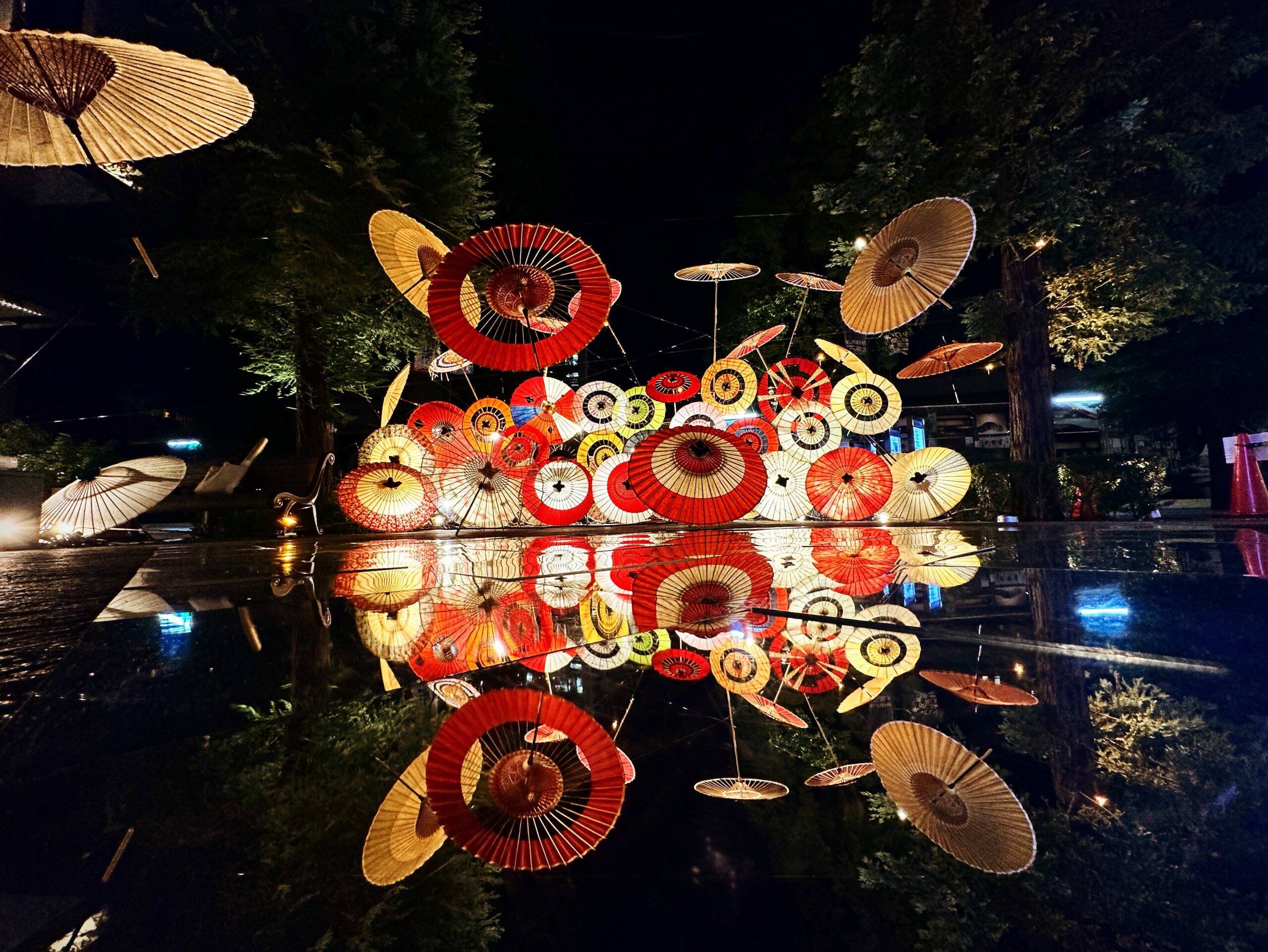
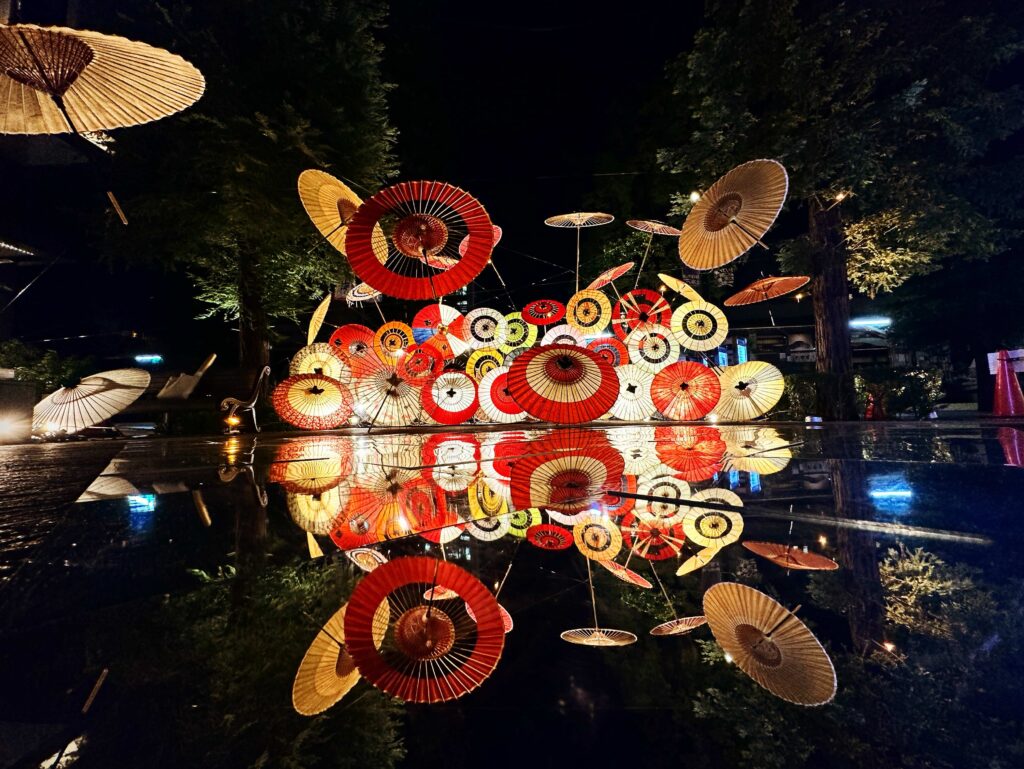
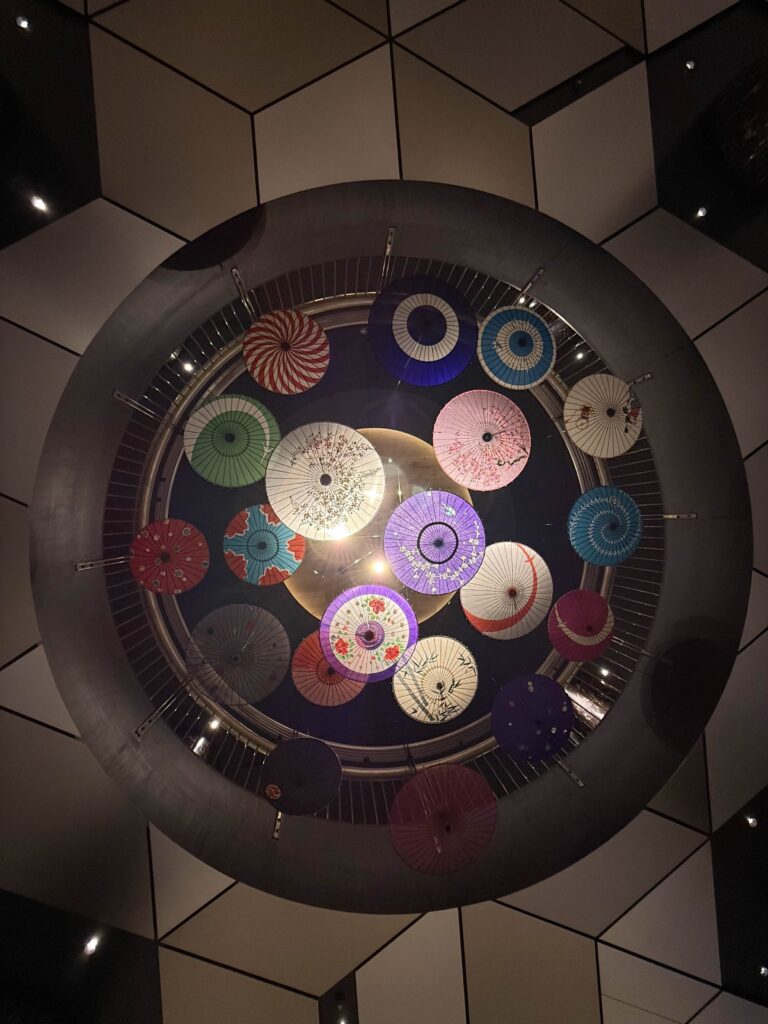
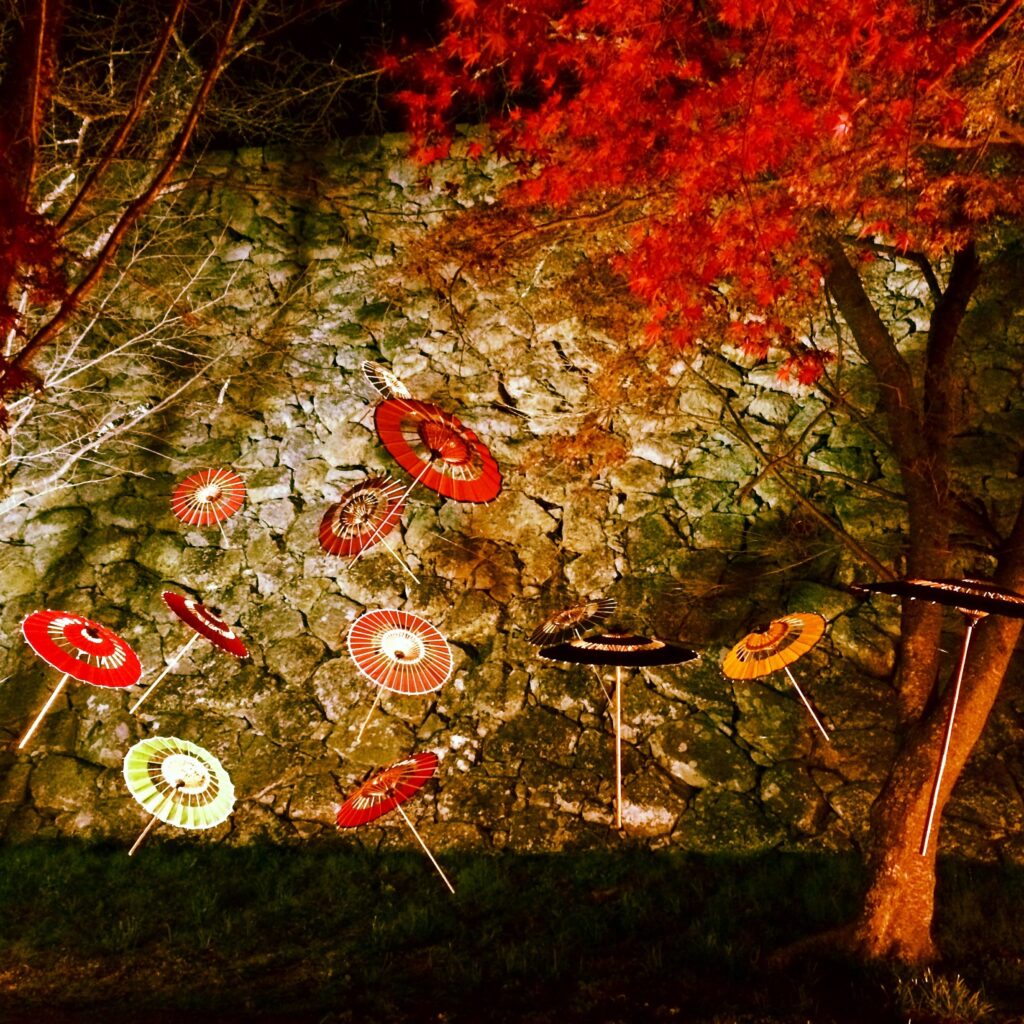
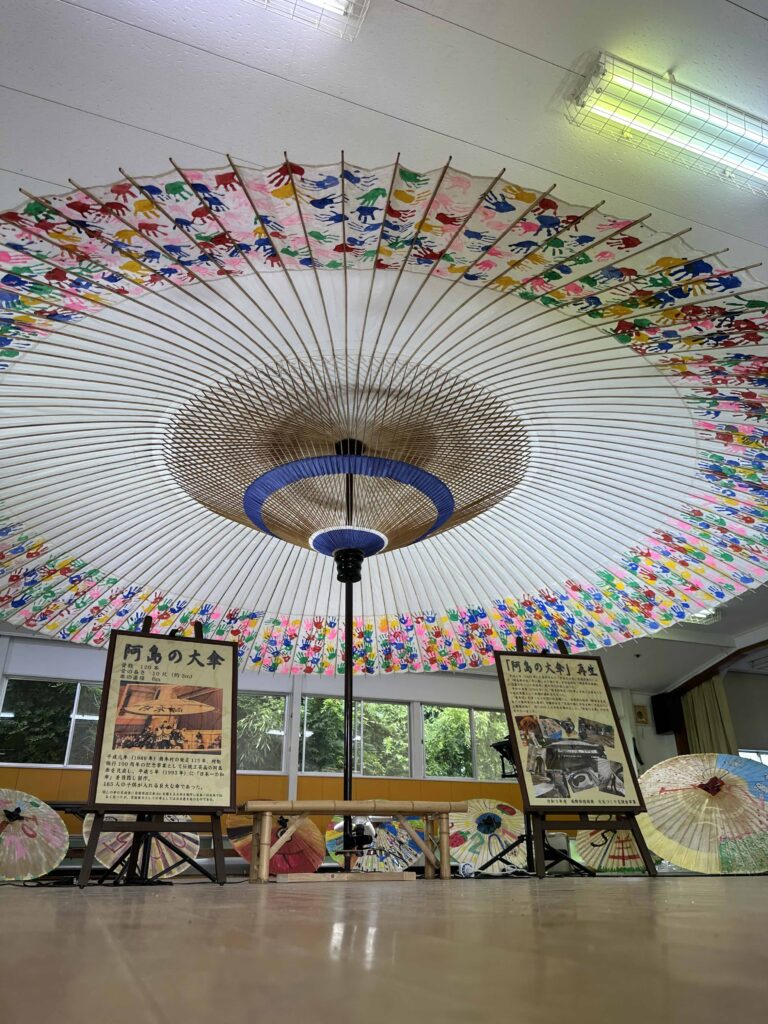
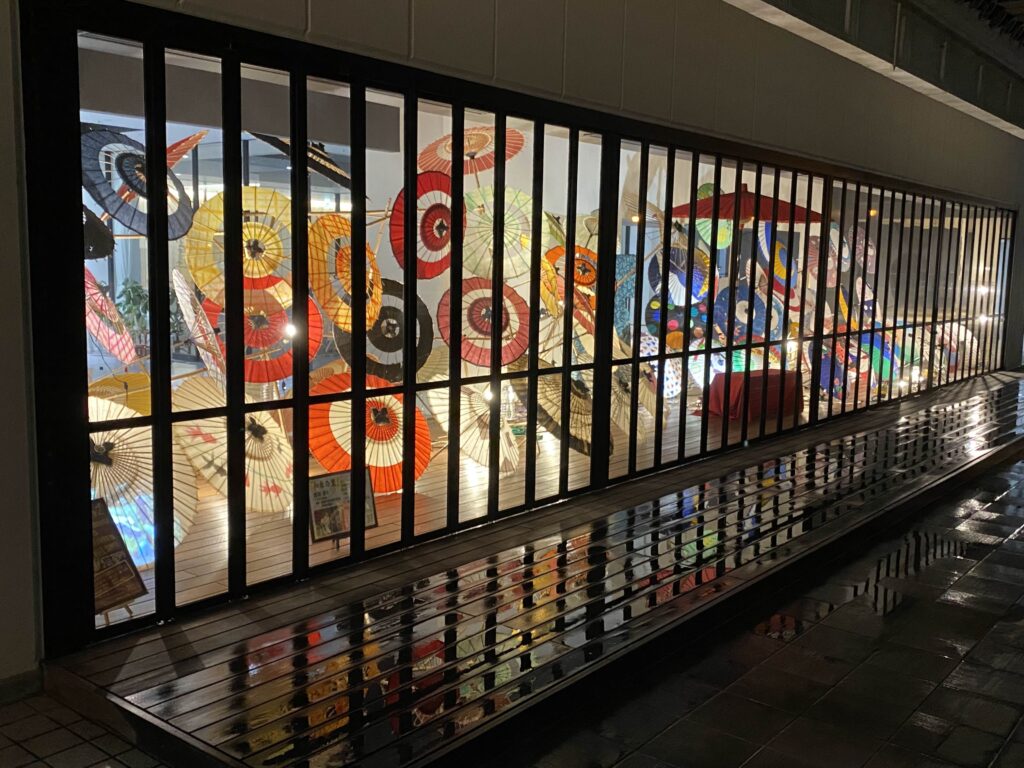
As a member of the Regional Revitalisation Corps in Mima City, Tokushima Prefecture, I conducted Japanese umbrella workshops, compiled reference materials, organised umbrella-making experiences, nurtured successors, curated exhibitions, and authored the regional educational book “What is a Japanese Umbrella? The Mima Chapter”. After my term ended, as a member of the Regional Revitalisation Cooperation Team in Takagi Village, Nagano Prefecture, I was involved in teaching Ashima umbrellas, creating reference materials, restoring Japan’s largest umbrella (6m diameter), organising reference exhibitions, researching Dondo-yaki festivals, and producing the book “What is a Japanese Umbrella? The Ashima Umbrella Edition”. Furthermore, I have consistently continued organising light-up events, Japanese umbrella design exhibitions, and reference exhibitions in various locations since I first became an umbrella maker. Beyond this, I persistently pursue activities to raise awareness of Japanese umbrellas through light-up displays, design exhibitions, and archival shows. For me, if something isn’t known, it might as well not exist. When residing in Kurashiki, I even staged guerrilla performances on my days off, taking a Japanese umbrella into town and asking passers-by, ‘Would you like to hold this?’
Q: I understand the reference materials and books you authored as a Regional Revitalisation Cooperation Team member include tool blueprints.
Alongside the making process, I ensure all tool drawings are included. Even those unable to make the tools themselves can commission them if they have the drawings. I believe the role of today’s craftsmen is to create an environment where aspiring future artisans don’t have to give up.
Q: What must be done now to preserve Japanese umbrella culture for the next 100 years?
There are no textbooks for Japanese umbrellas, and very few comprehensive records remain from the 1950s onwards. Therefore, I consider collecting, preserving, and storing materials to be the top priority. When I first began making Japanese umbrellas, I was told I was ‘30 years too late’; now, I’m told I’m ‘50 years too late’. I want to bridge that 50-year gap with my own hands, so future craftsmen won’t be told they’re ‘100 years too late’. I feel a responsibility to leave behind evidence in the form of materials to connect the tradition to the next generation.
Q: Are there any new fields or projects you wish to challenge yourself with?
Having completed my term in Takagi Village, I have now returned to my hometown of Tsuyama City and am preparing to restart the “Kobo Wagasa-ya” workshop. Concurrently, a project to establish a Japanese umbrella museum has also begun. I intend to thoroughly research the history of Japanese umbrellas across the nation and create a place where knowledge is accessible to anyone who visits. Wagasa is not a culture meant to be monopolised by any one individual. So that the next generation can learn and inherit it without hesitation… With this sentiment, I am organising information and preparing to pass it on to the future.
PROFILE
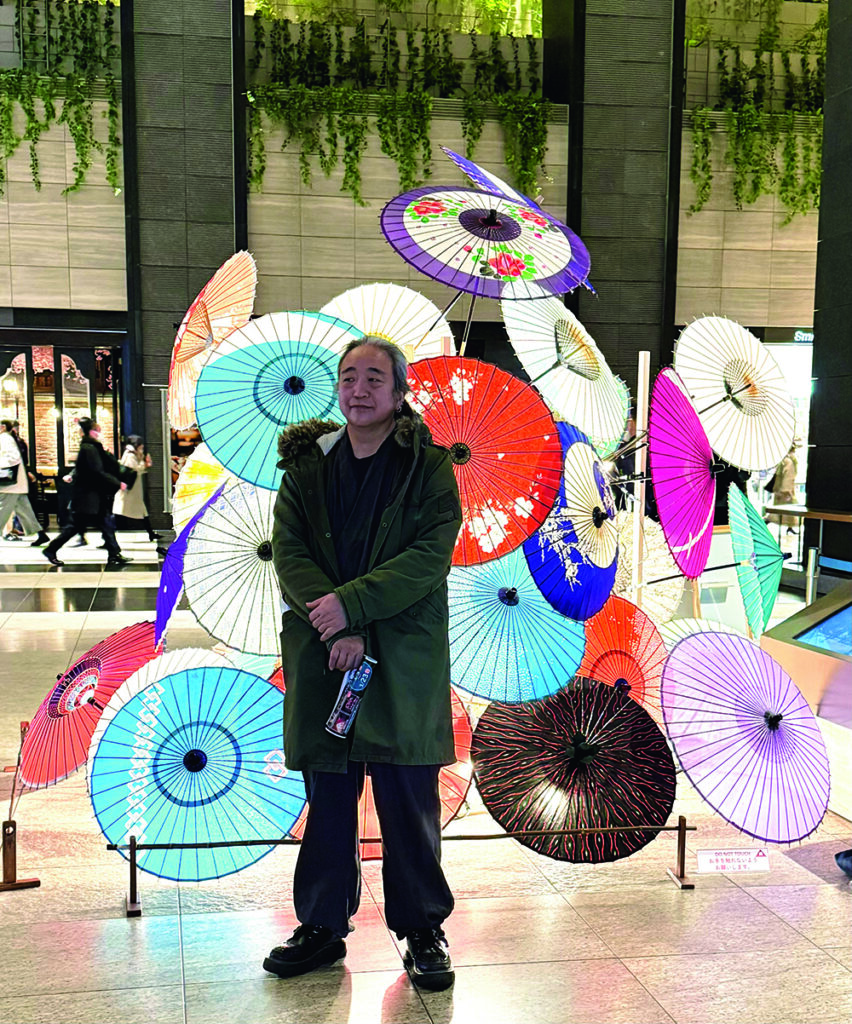
Wagasa Craftsman
Tabito Kobayashi
Born in Tsuyama City, Okayama Prefecture. Developed an interest in wagasa after meeting Hiroshi Sakata, a wagasa craftsman in Yonago City, Tottori Prefecture. Following Sakata’s sudden passing, he began making Japanese umbrellas. He handles nearly every stage of production alone, from crafting the ribs to covering the canopy and finishing the umbrella. He also collects and studies old texts and Japanese umbrella-related artefacts, reviving Edo-period umbrellas and lost techniques. He seeks out Japanese umbrellas made within Okayama Prefecture, working to revive the extinct ‘Okayama-gasa’, ‘Kurashiki-gasa’, and ‘Sakushu-gasa’ styles and compiling reference materials.