
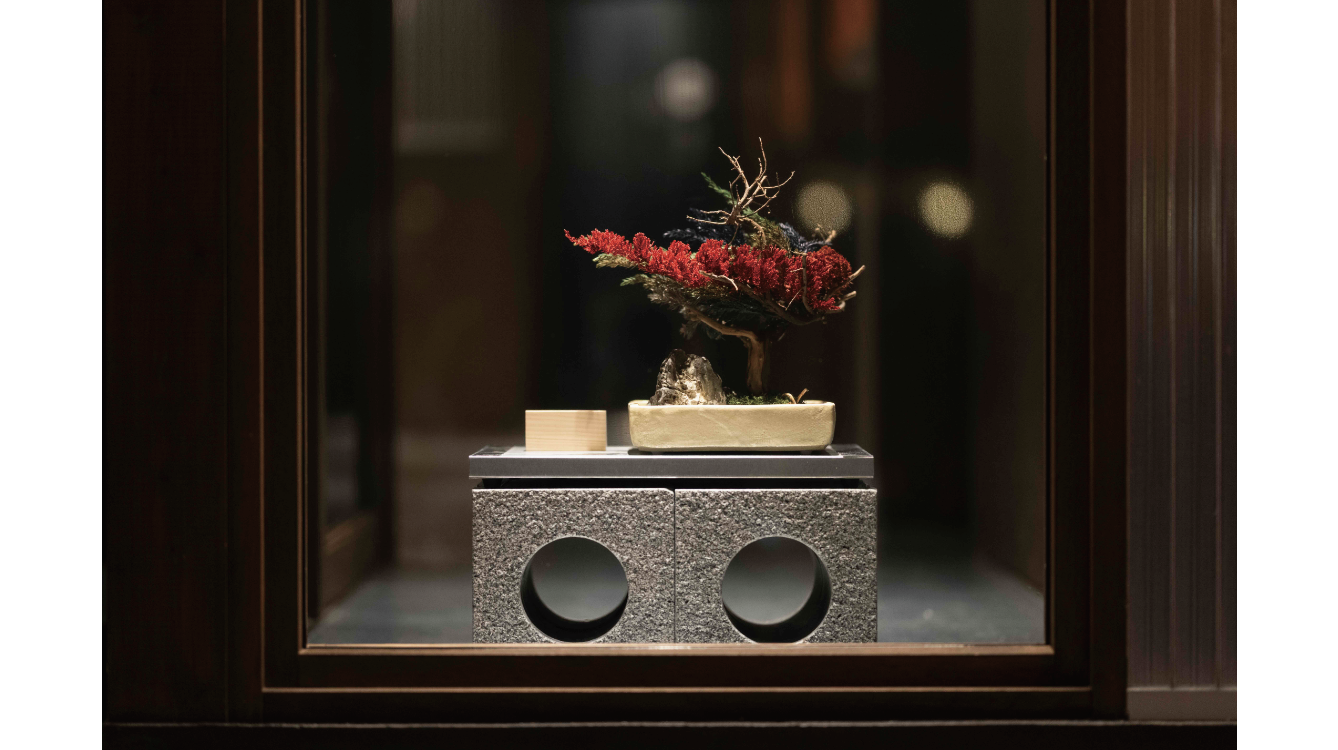
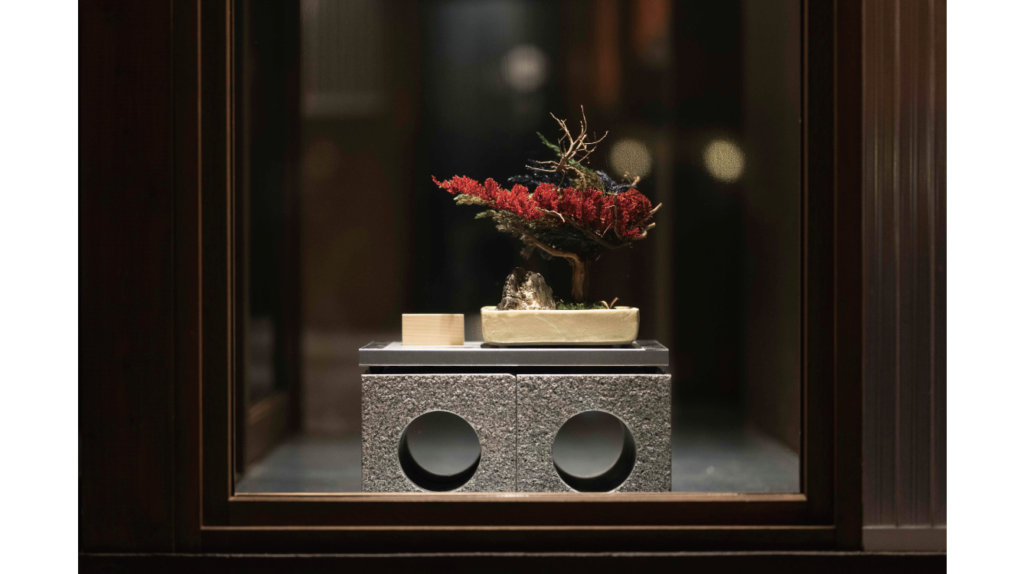
Trunks and branches that have marked the passage of decades, and sometimes centuries, continue to exude an overwhelming presence even after reaching the end of their natural lives. Bonsai artist Tatsu Suzuki discovers new possibilities for beauty in this, connecting ‘the end’ to the next chapter of the story. It is an attempt to re-examine the very concept of time that the culture of bonsai has long embodied. Why did Suzuki choose to engage with withered bonsai? Is ‘regenerative bonsai art’ an extension of tradition, or is it a wholly distinct form of expression? We explore his thinking and practice.
Q.When was the first time you were moved by bonsai, Mr Suzuki?
It began when I was travelling the world in my twenties. I joined an apparel company straight after graduating, but after visiting overseas for the first time on a company trip, I could no longer suppress the urge to ‘see more of the outside world’. Having studied landscape design at university, I wanted to see the natural beauty of the world with my own eyes. Over the course of about three years, whilst travelling through 33 countries, what struck me most was how often people I met in various countries would say to me, ‘Japanese bonsai is cool, isn’t it?’ Bonsai had already become a global brand as ‘Japanese Bonsai’. Through the eyes of the outside world, I realised once again that bonsai is a culture that represents Japan. It was from there, when I began to study the history and spirituality of bonsai, that it all began.
Q.Could you tell us how you came to develop ‘Regenerative Bonsai Art’?
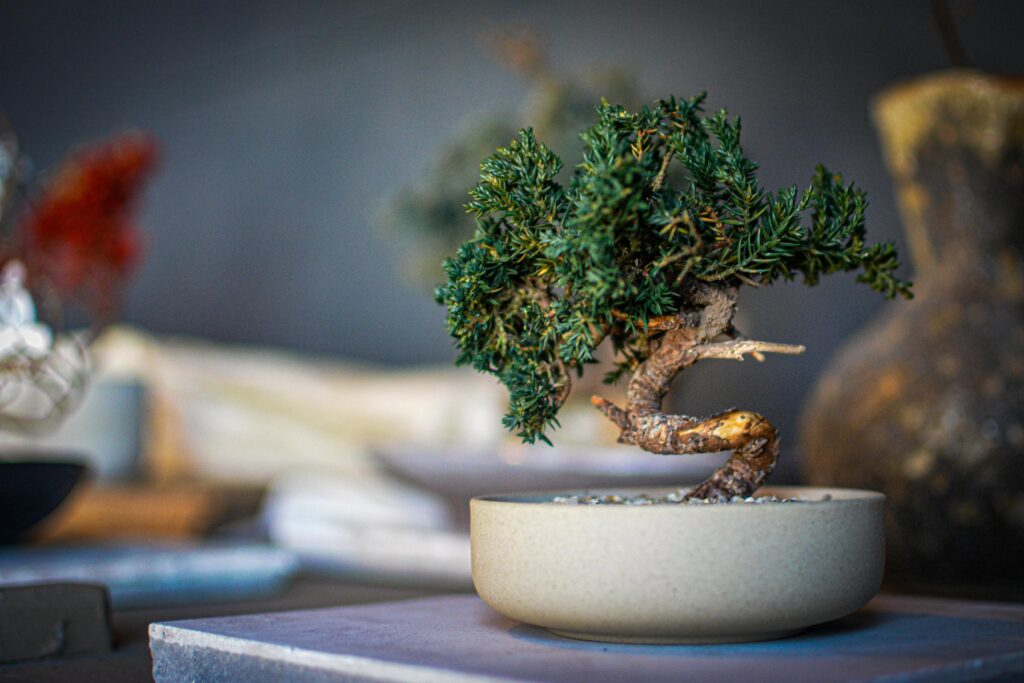
After returning to Japan, I set up my own business in the fashion industry, exploring ways to combine fashion with bonsai, such as selling T-shirts printed with bonsai designs. However, as I became more involved in the bonsai industry, I came to understand the harsh realities it faces: an ageing population, a shortage of successors, and the outflow of outstanding works overseas. Whilst highly regarded abroad, in Japan the prevailing image is that ‘it looks difficult to maintain’. To bridge that gap, I began to wonder if there was a way to breathe new life into this traditional culture. It was around that time that a bonsai nursery I had a connection with approached me, asking, ‘We’re going to dispose of some bonsai that have died; would you like to take them?’ Plants are living things, so no matter how carefully you nurture them, they will eventually reach the end of their natural life. However, the shapes of the trunks and branches, cultivated over decades or even centuries, still exude an overwhelming sense of power even after they have died. Standing before them, I felt that ‘it would be such a waste to simply throw these away’. So, using the withered bonsai as a base, I reconstructed them with new leaves preserved using a special technique, transforming them into art pieces that could be enjoyed indoors. The response was far beyond my expectations. Through posts on social media, the circle of people who resonated with this grew, and gradually my connections with bonsai nurseries increased.
Q.Did your independent activities lead to your connection with ‘TAIZAN Co., Ltd.’, the company you currently work for?
Yes. TAIZAN has a philosophy known as ‘Wabi-Sabi Luxury’. This is the philosophy of TAIZAN’s founder, Taichi Toya, who redefined wabi-sabi as the ‘beauty of nature and time’ on a cosmic scale and elevated it to a form of luxury. The moment I encountered that unique aesthetic sensibility, I felt a deep resonance and was profoundly moved, and I resolved to ‘aim for the world as a brand of the TAIZAN Group’. Currently, as the head and artist of the company’s regenerated bonsai art division, ‘WITHERS’, I am working tirelessly to enhance the value of bonsai art.
Q.What do you prioritise when selecting ‘withered bonsai’ as raw materials?
Underlying this is the philosophy of ‘connecting the history and spirit of bonsai’. On top of that, I value pieces where the unique form of the bonsai stands out. In particular, the twisting of the trunk and its beautiful curves are the result of years of care. I select specimens that clearly embody this ‘essence of bonsai’. At the same time, I aim to make the most of materials that cannot be used in my own works. One such initiative is our workshops. Using withered trunks as a base and preserved leaves, participants themselves can revitalise the bonsai as art. By providing an accessible, affordable experience, I hope to breathe new life into as many materials as possible.
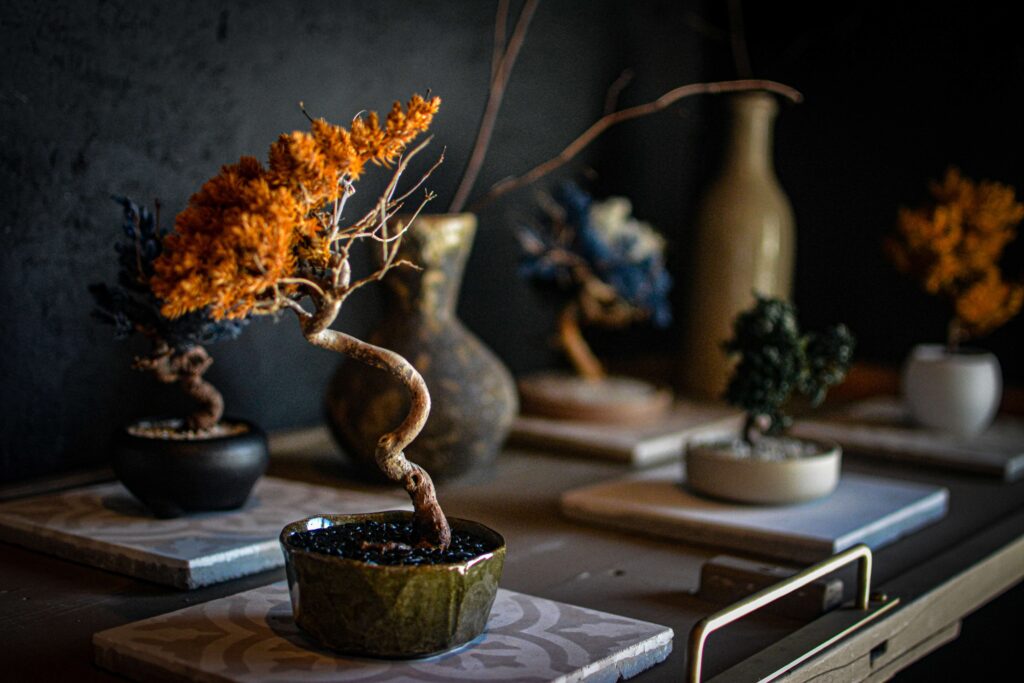
Q.The phrase ‘connecting the history and spirit of bonsai’ is particularly striking. When you receive a commission from a client, do you also ask about the background of their dedication to bonsai?
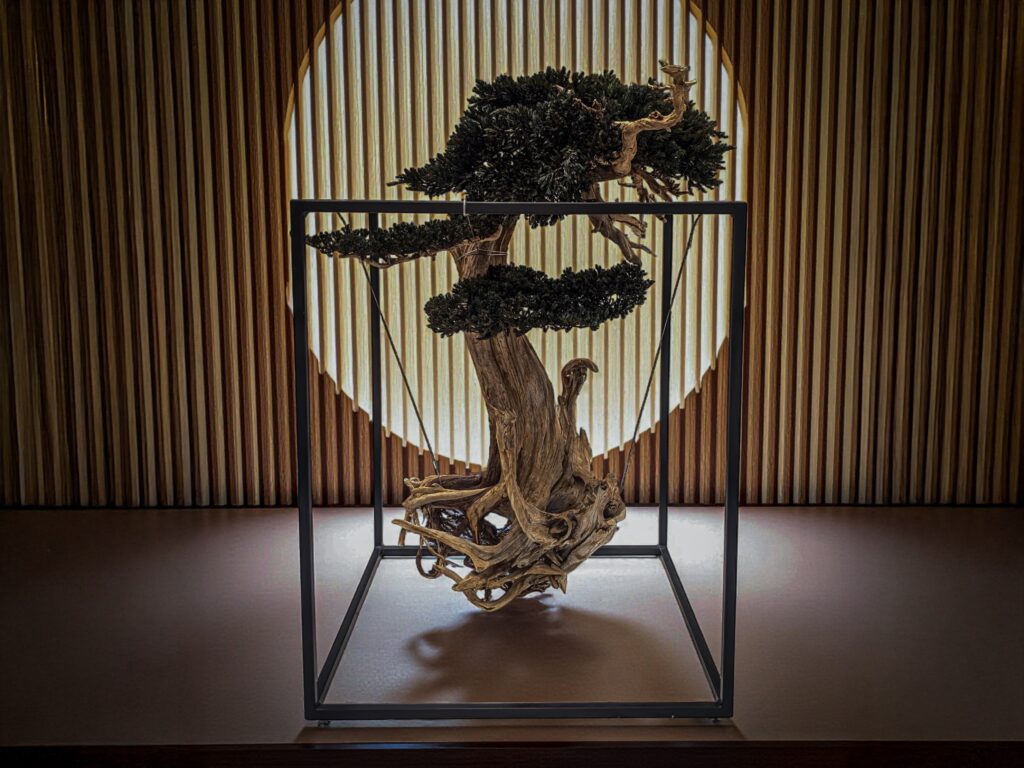
Although we acquire much of our material from bonsai nurseries, when we receive a commission from a private client, we always ask about their memories and the story behind the plant. Recently, I was consulted by the owner of a restaurant. They had been carefully tending to a magnificent bonsai that had been gifted to them to celebrate the opening of their business, but it had eventually withered, likely due to being kept indoors for a long period. When they told me, ‘I can’t throw it away because it was a gift from someone dear to me’, I proposed transforming it into a new form as ‘revitalised bonsai art’. That piece is now set to be passed on as a symbolic display for their new shop. The sentiments of the giver and the time invested by the recipient—encapsulating both and passing them on to the next generation. This was the moment I became convinced that this was precisely the work I wanted to achieve.
Q.Which stage of the production process requires the most care?
Firstly, the preparation of the material. Bonsai that have spent many years in small pots have countless fine roots entangled in the soil, densely compressed into a single hard mass. Dead bonsai, in particular, are often left untouched for long periods, and the soil can become so hard that it must be broken up with a large spade. However, if too much force is applied, the bark, branches and roots will be damaged. As the beauty of the root system is a major attraction of bonsai, we carefully remove the soil without damaging it, smooth the bark, and bring out the inherent aesthetic form of the bonsai. It is a process that takes both time and effort, but it is a crucial task that determines the impression of the finished piece. Literally covered in mud, we carefully reveal the form in which it was once nurtured.
Q.Could you also tell us about the preservation process?
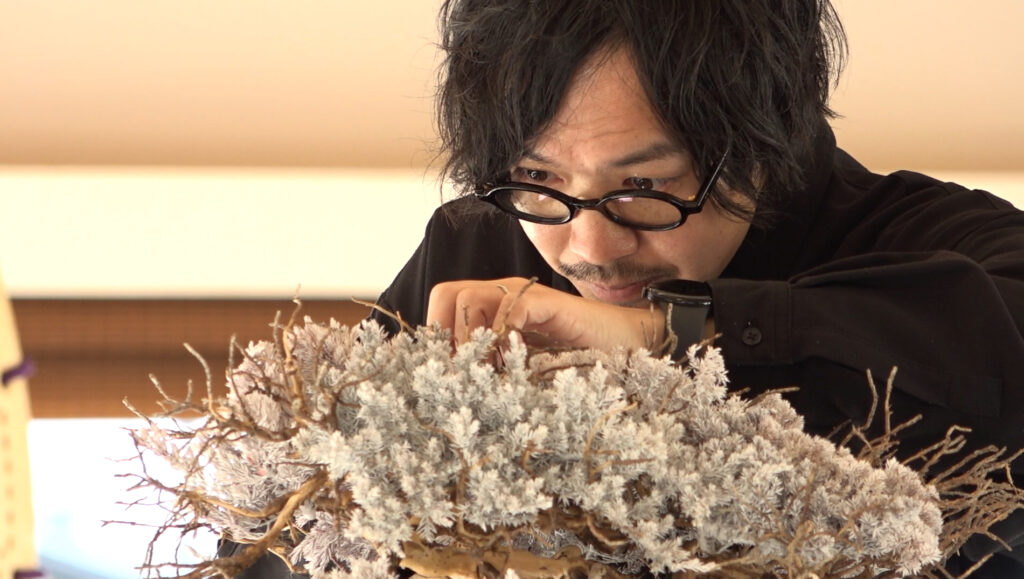
When preserving leaves, it is generally standard practice to have them absorb the solution from the roots. However, compared to flowers, leaves are less receptive to the solution, and there are few established technical methods. When I first started, it was a constant process of trial and error. I altered the solution’s composition, tested the differences between outdoor and indoor environments, and adjusted the soaking time. I re-learned the structure of plants, deepening my understanding from the basics, such as ‘how is water drawn up?’ and ‘how can transpiration be encouraged?’. Through this cumulative process, I eventually achieved a state where the solution permeates uniformly right to the tips of the leaves, preserving them whilst maintaining their supple texture. Once finished to this standard, they can be kept in the same condition semi-permanently. That said, there are individual differences in bonsai; even under the same conditions, some succeed whilst others do not. Precisely because they are living things, they cannot all be identical. What makes it even more difficult is the variation in shape. Not only do the bonsai themselves differ, but even a single leaf can vary in shape and density. The challenge lies in how to harmonise such ‘variability’ within the artwork. The process of discerning the individual character of the material and blending it into the overall composition is the part of the work that demands the greatest concentration from me as an artist.
Q.Do you think that ‘unpredictability’ also contributes to the appeal of the work?
I believe so. I sometimes add colour to the preservative solution, but depending on how the leaves absorb it, unexpected gradients can emerge. Older leaves absorb less, so only the younger ones may take on vivid hues—unpredictable changes like this occur. If I find such accidental colouring beautiful, I may deliberately leave it untouched and incorporate it into the piece as it is. Rather than controlling everything, I accept the individuality of the materials. I consider this approach to be a form of respect for the very essence of bonsai.
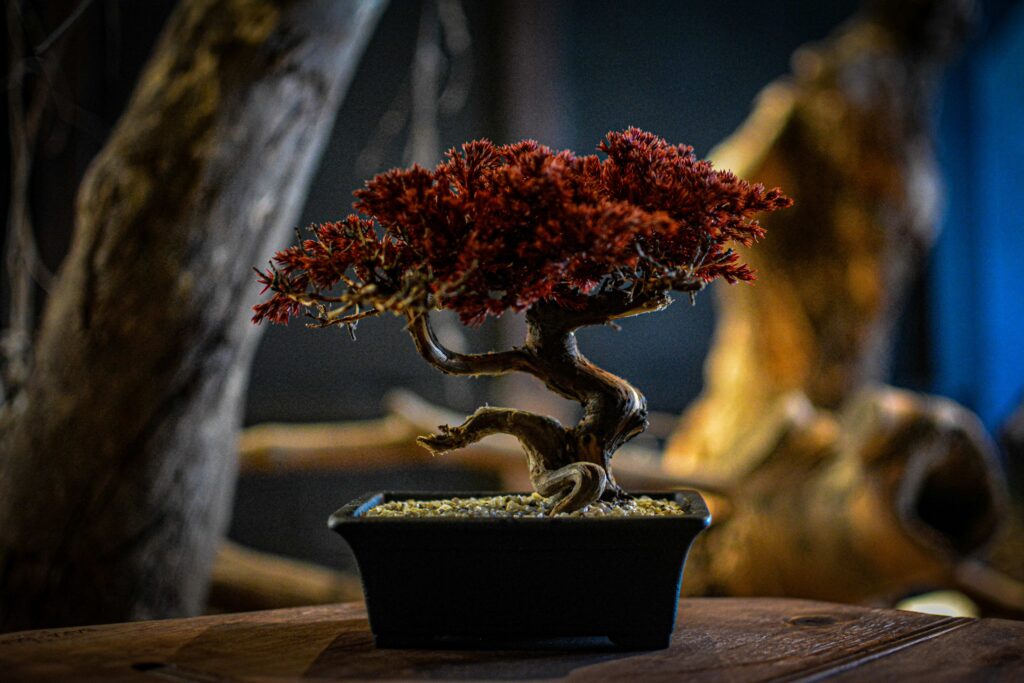
Q.How do you balance the traditional rules of bonsai with your own individual style?
In bonsai, there are clear principles for creating a beautiful composition. The trunk is made the focal point, the branches and foliage are arranged to form ‘shelves’, and negative space is left between the layers. It is believed that this approach brings out the full charm of the composition. I understand and respect this theory. However, if one merely reproduces the tree’s natural form faithfully, the artistic expression becomes weak. For example, whilst it is generally accepted practice to remove a ‘protruding branch’—one that extends forward and obscures the trunk—as an ‘undesirable branch’, I sometimes choose to leave it in place and arrange the foliage to face the viewer. This is because creating a tension between the presence of the trunk and the character of the foliage generates a new sense of tension and a contemporary impression. Building upon tradition, deciding what to preserve and where to deliberately deviate—I believe that choice is the very essence of my own artistic expression.
Q.Can you visualise the finished form the moment you see the material?
For the most part, I explore it as I work. Both the bonsai and the leaves differ in shape and texture from one piece to the next. I combine them, remove them, and rearrange them. Through this process of trial and error, there comes a moment when a composition clicks into place and I know: ‘This is it.’ With smaller pieces, it occasionally takes just a few dozen minutes to decide, but the more compelling the material, the more time I might spend—hours or even days—searching for a position that does not detract from its inherent beauty. It is a period of persistent dialogue, continuing until I find the arrangement that brings out the material’s full potential.
Q.I imagine you have encountered various setbacks whilst creating your work; have you gained any insights from these?
The realisation is that, as long as I am working with nature, I cannot rely solely on my own intentions to complete the piece. When I first began creating recycled bonsai art, my thoughts may have been dominated by ‘how I wanted to express myself’. However, as I gained experience, I began to listen closely to ‘what the materials themselves were asking for’. Each trunk and branch has its own history, and each leaf has its own nature. I accept the premise that certain things cannot be changed, and then seek out what I can do. My approach has naturally shifted towards this mindset.
Q.Are there any works or projects from your career so far that have left a lasting impression on you?
My collaboration with the Mino washi brand ‘KIKKA’ is particularly memorable. I adorned a reclaimed trunk with cherry blossoms crafted from Mino washi, finishing it as a single cherry bonsai. The flowers were meticulously handcrafted one by one by a washi artisan, and I was deeply moved by their exquisite craftsmanship. I am currently based in Kani City, Gifu Prefecture. Gifu is a region where a culture of craftsmanship thrives, encompassing Mino washi, Hida woodwork and Mino ware. When traditions rooted in the same land intersect, new forms of expression are born. This project allowed me to truly experience that potential. Connecting local techniques and spirit in a contemporary form, and passing them on to the next generation – I hope to continue pursuing such collaborations in the future.
Q.Mr Suzuki, you have also developed the world’s first ‘Light Bonsai’ and ‘Aroma Bonsai’. What is the reason for incorporating elements such as light and scent?
‘Light Bonsai’ and ‘Aroma Bonsai’ were born from an idea conceived by TAIZAN owner Taichi Toya. At the heart of this concept lies Toya’s vision to ‘reconstruct bonsai through the five senses’. Light and scent are realms that living bonsai can never truly enter. Unbound by convention and incorporating ‘play’ into his creative process, Toya’s ideas effortlessly transcend existing boundaries – such as displaying bonsai art on the exterior walls of a mobile tea house as he travels through the city. Yet, at the very core of this lies a deep respect for tradition. Light Bonsai and Aroma Bonsai were created to go beyond existing frameworks and to ignite the sensibilities of those who had previously shown no interest in bonsai.
Q.What aspects of bonsai culture do you wish to pass on to the next generation?
What we wish to pass on is history and the sentiments behind it. Bonsai embodies layers of time spanning decades and even centuries. It is only through the painstaking accumulation of daily watering and tending that beautiful forms are born. I hope more people will come to recognise the value in the preciousness of that time. Furthermore, I believe the perspective that the story continues even after the tree has withered elevates the status of bonsai. To convey this appeal, what I can do—to put it frankly—is ‘create cool works’. While it is important to articulate these sentiments, nothing begins unless people are first interested. Presenting bonsai in the form where they look most beautiful: as an artist, I approach this with a strong sense of responsibility and dedication.
Q.If there are any themes or collaborations you would like to take on in the future, please tell us.
I am planning an exhibition in collaboration with a bonsai garden, where I will juxtapose regenerated bonsai art with living bonsai. Bonsai is, by its very nature, a culture in which life and death are closely intertwined. There are techniques, such as ‘jin’ (god) and ‘shari’ (relics), where trunks and branches are deliberately left to wither. However, there have been very few attempts to depict the story that unfolds after the entire tree has withered. I feel there is new potential in this. By placing living and withered bonsai in the same space, I aim to visualise the cycle of life and the passage of time, and to present this as a new aspect of bonsai’s appeal.
PROFILE
Bonsai Artist
Shin Suzuki
Born in Nagoya in 1988. Artist behind the regenerative bonsai art series ‘WITHERS’. Representative Director of the Japan Regenerative Bonsai Association. He has been close to nature since childhood and studied landscape design at university. From 2012, he spent approximately three years travelling through 33 countries, witnessing how Japanese bonsai is recognised and appreciated across borders as ‘BONSAI’, and became deeply drawn to the sense of time and spirituality inherent in this culture. Upon returning to Japan, he launched an apparel brand, reinterpreting the sculptural beauty of bonsai through graphic design. Eventually, shocked by the reality that withered bonsai were being discarded at nurseries, he founded the regenerative bonsai art brand ‘WITHERS’ in 2023, based on the concept of ‘beauty even in withering’. He imbues bonsai that have reached the end of their natural life with new artistic expression, reconstructing them as works that preserve the passage of time. In addition to exhibitions and sales at department stores in Japan, her work has been exhibited overseas in places such as New York and Vietnam. She has presented her work to the Grand Bitan Palace in Bali. She has received Excellence Awards at the Kani City Art Exhibition and the Minokamo City Art Exhibition, and won the Grand Prize at the GIFU IDEA PITCH CONTEST. Official website: https://withers.jp