
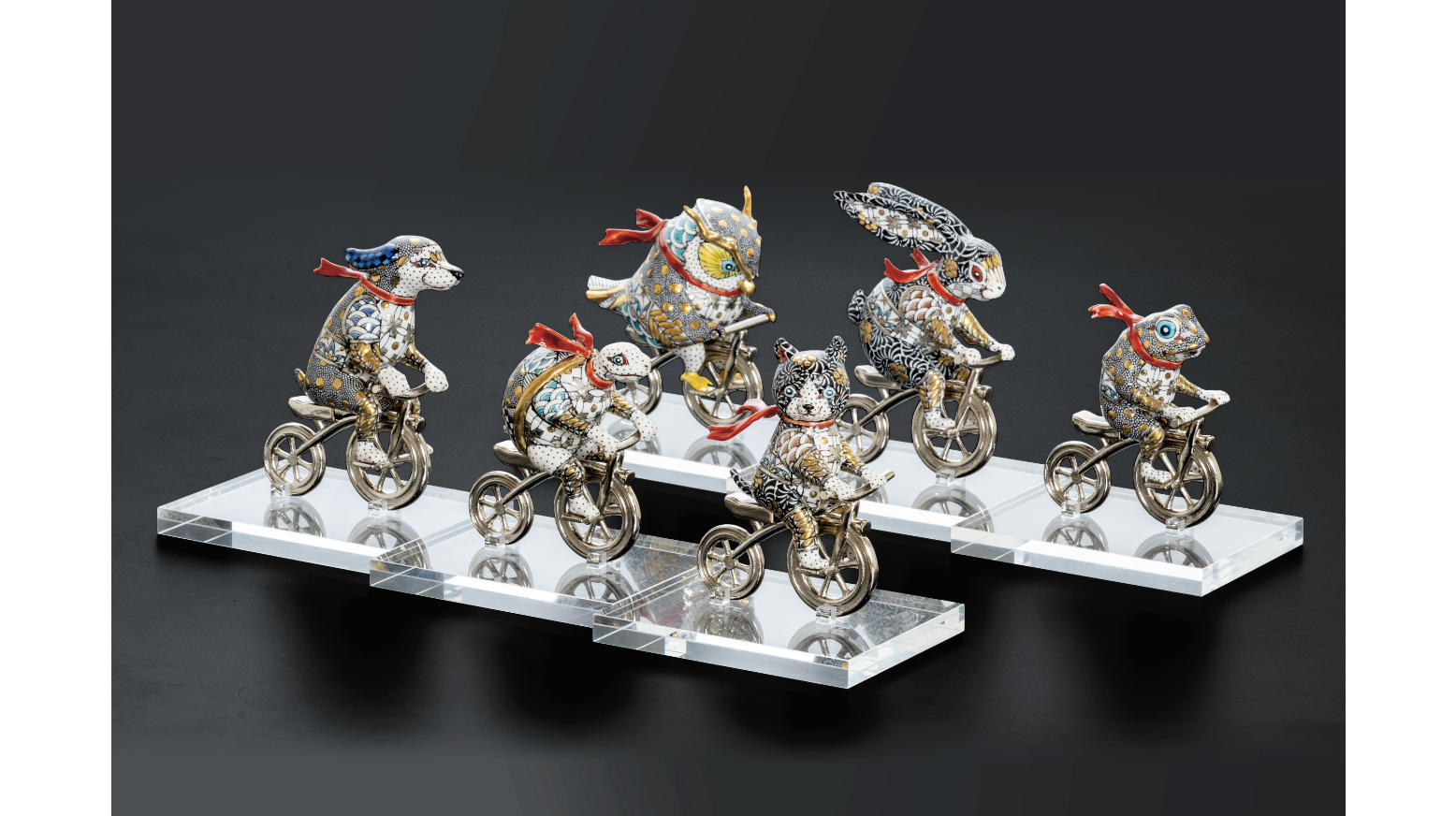
Owls, rabbits and whales come to life, leaping and dancing across the pure white surface of the vessels. The works of Kutani ware artist Kazuyoshi Kitamura are traditional crafts, yet they are brimming with a narrative quality, as if a scene had been plucked straight from a picture book. We spoke with him about his love of painting, which he has cherished since childhood; the trial and error involved in establishing his unique style; and his vision for the future of traditional crafts. We listened to the story of his creative journey, as he continues to pursue his own form of expression, unbound by preconceptions.
― Did you enjoy making things and drawing from a young age?
I’ve loved drawing since I was a child, and I used to dream of becoming a manga artist. However, as I grew older, I began to see the reality of the situation and realised that ‘it might be too difficult for me’. After graduating from high school, I enrolled on a ceramics course at an art-focused junior college, and it was there, when I first handled clay, that I had my first encounter with Kutani ware.
―Did your father, the Kutani ware artist Takashi Kitamura, ever teach you pottery?
My father never taught me anything about Kutani ware, nor did he ever encourage me to ‘make a career out of Kutani ware’. I myself had a strong desire to do something different from my father, and even now that I’m an artist myself, my father never asks me about my work, nor do I ever show him mine.
―After graduating from junior college, you went on to the ‘Ishikawa Prefectural Kutani Ware Technical Training Centre’ in Nomi City, Ishikawa Prefecture. What did you learn there?
There are various techniques in Kutani ware, and over the course of three years―combining the undergraduate and postgraduate programmes at the training centre―I learnt the entire production process. It was only for my graduation project that I was able to create works freely, so I did some painting and made sculptural pieces.
―How did you arrive at your current artistic style?
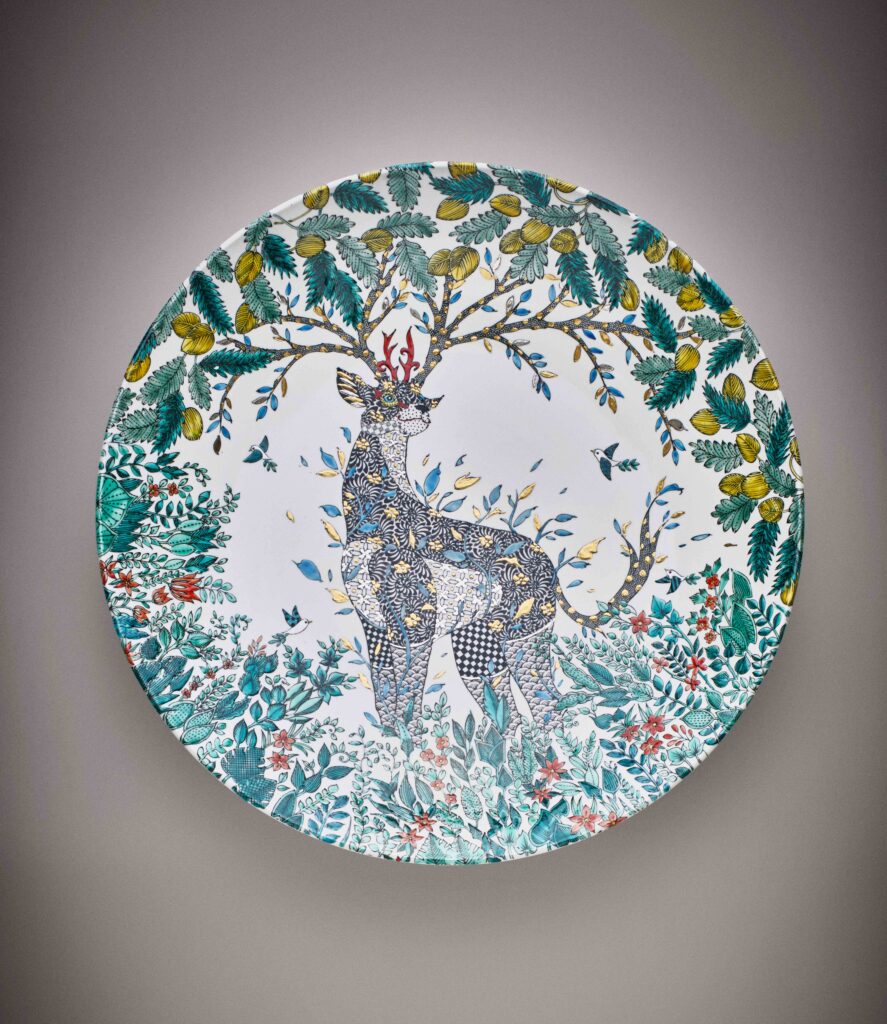
After graduating from the training centre, I began my career as an artist in my mid-twenties, but at first, my work didn’t sell at all. Although I tried various techniques, I couldn’t gain any confidence, and for a while I struggled to find my own style using the ‘kokusai’ technique, which involves layering colour over a black base. But eventually, I simply reached a dead end. Above all, I simply stopped finding the process enjoyable myself. So, I went back to basics. I’d always loved drawing, and ever since my apprenticeship, I’d found the state of black line drawings in ‘gosu’―before any colour was added―irresistibly beautiful. ‘I’ll make the charm of these lines the focal point and paint what truly excites me.’ It was with this in mind that I began my ‘Senbyō Iro-e Kinsai’ style, in which I draw animals in goshu and finish them with gosai pigments and gold leaf. It’s actually only been in the last ten years or so that I’ve arrived at this style and started to feel a sense of fulfilment, thinking, ‘This is it.’
― Ms Kitamura’s works are striking for their meticulous detail, and they also possess a certain manga-like charm.
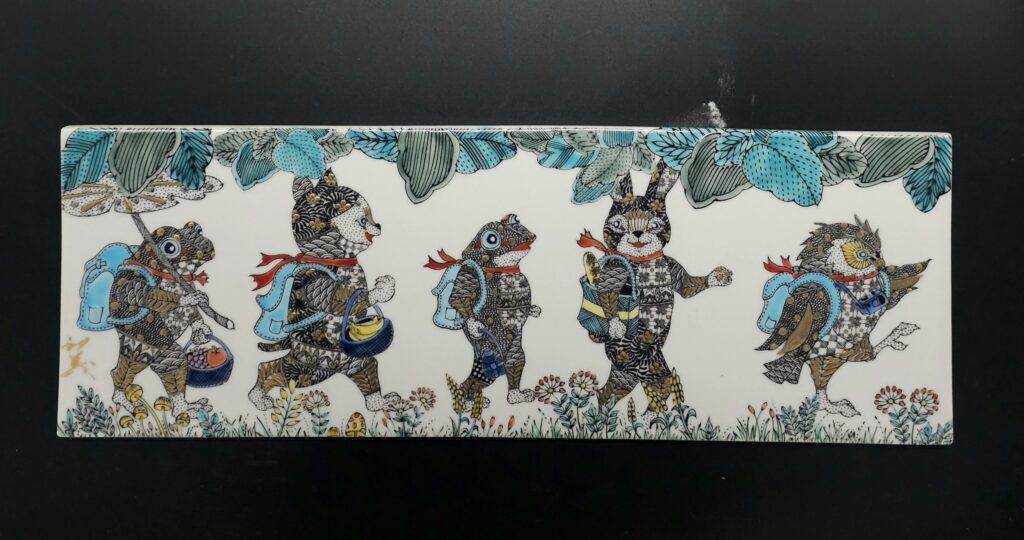
A major feature of my work is giving the animals human-like expressions and movements―such as an owl skipping along with a rucksack on its back. I then fill the space around these motifs with a variety of patterns. In Japan, there is a long-standing tradition of filling the canvas with patterns, and I am strongly drawn to the fascination of that density. The more I paint, the denser the composition becomes, and the closer it gets to completion. It feels as though tiny jigsaw pieces are piling up to create a powerful impact; as I paint, my own sense of satisfaction grows.
―Could you tell us what you consider to be the unique appeal of Kutani ware?
For example, simply having a single piece of Kutani ware on the dining table instantly brightens the atmosphere.
― The gold decoration is also striking.
For me, gold is not a ‘special embellishment’ but ‘part of the paint’. That is precisely why I always incorporate it into every piece. The unique lustre and splendour it takes on when fired cannot be replicated by any other colour. Furthermore, Ishikawa Prefecture is renowned nationwide as a centre for gold. Using gold generously and expressing its beauty is also a matter of pride for me as an artist practising a traditional craft born in this region.
――You are actively engaged in collaborations with other industries, such as the ‘Kutani-yaki trainers’. Could you tell us why?
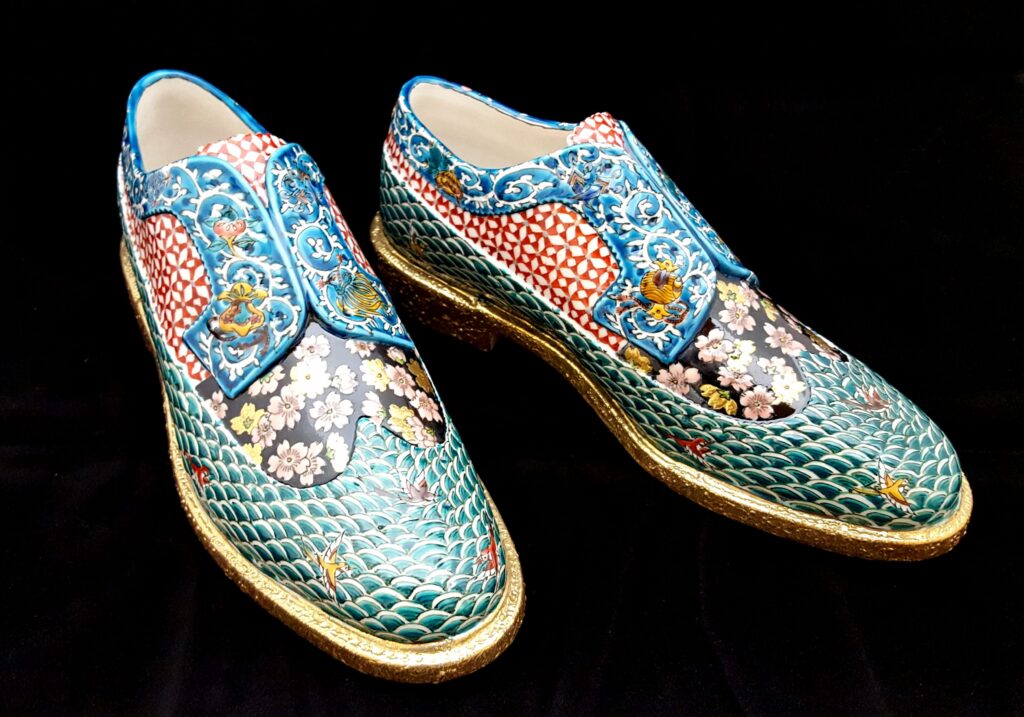
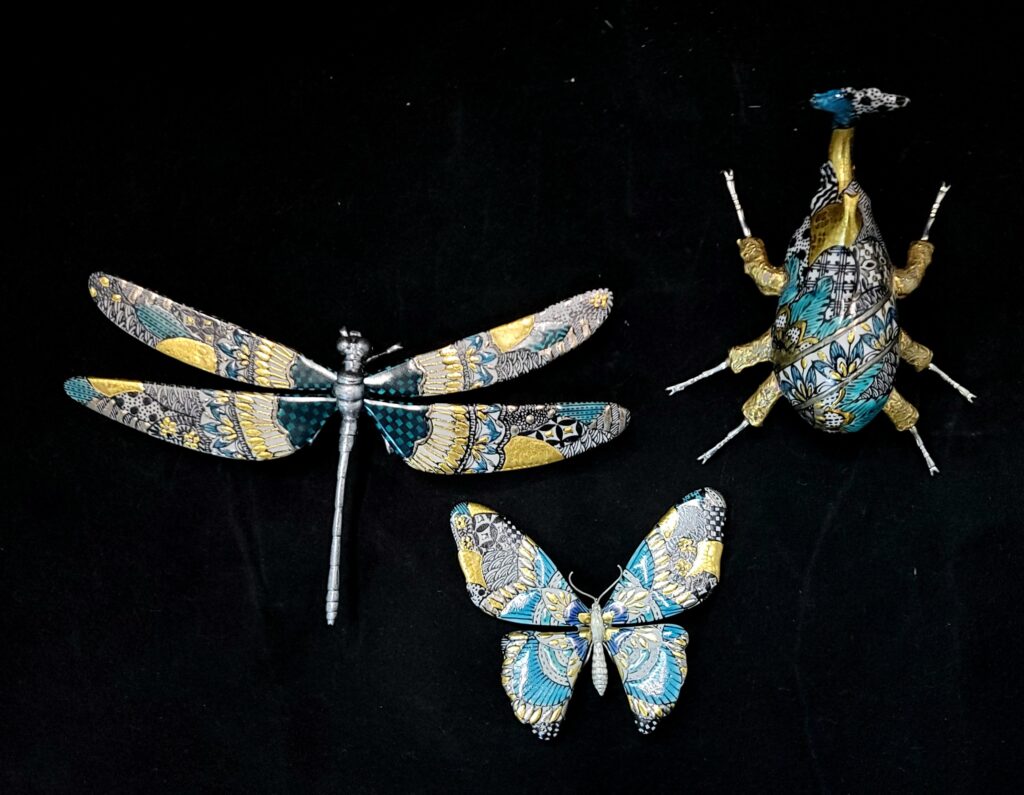
The major catalyst was when I created the ‘Kutani-yaki rhinoceros beetle’. At an exhibition, young people who had previously shown no interest in crafts stopped in their tracks and eagerly took photographs. I was struck by that sight. I realised that although the production process and techniques remained the same as ever, simply changing the motif could elicit such a different reaction. Subsequently, I was approached by Takara Tomy, which led to the creation of the ‘Kutani-yaki Choro-Q’. This, in turn, led to work involving the creation of various three-dimensional objects―such as shoes and violins―in the Kutani-yaki style.
――You are also actively pursuing collaborations with pop culture.
I believe it is important to create a pathway whereby people who have no interest in Kutani ware―or who are not even aware of it―can use items they find ‘cool’ or ‘interesting’ as a gateway to subsequently encounter traditional crafts. That is precisely why I believe collaborations with companies from other sectors, and initiatives involving pop culture such as Gundam and Evangelion, hold such great significance. The patterns and colours of Kutani ware embody a distinctly Japanese aesthetic sensibility. At the same time, Japanese companies and characters also serve to convey Japan’s unique culture and values to the world. By combining Kutani ware with these elements, we can convey the charm, appeal and coolness of traditional patterns in a more natural way. I believe this could serve as an opportunity for not only inbound visitors but also those who have never previously taken an interest in crafts to feel a closer connection to Japanese culture.
―Is there anything you are mindful of in order to create your own unique expression whilst upholding tradition?
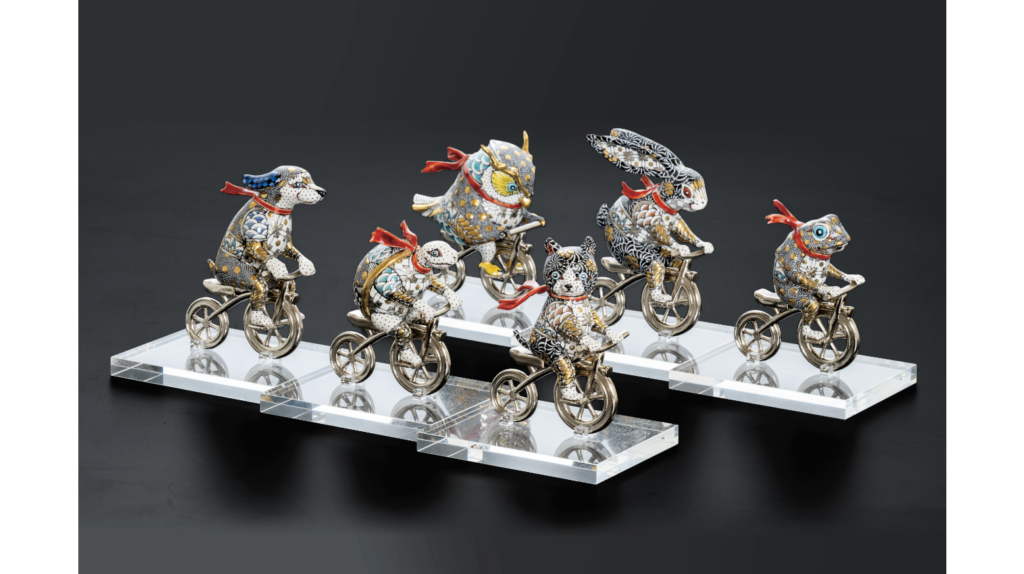
In this day and age, simply preserving the techniques is not enough to ensure that tradition endures. Traditional crafts are, by their very nature, beauty found within everyday life. Even if people recognise the quality of an object, if they think, ‘I don’t know how to display this in my home’, then the craft cannot survive. That is why I consciously create small pieces, such as the rabbit on a bicycle sculpture. They are the perfect size to be casually displayed on top of a shoe cupboard in a flat or nestled beside the television. I consider the space and the context in which they will be used. I believe that unless we give shape to these ‘suggestions for modern living’, tradition will not be passed on.
―In the world of traditional crafts, there are often values that dictate ‘how things ought to be’. How have you dealt with that kind of atmosphere?
Of course, I’ve been told that ‘your work is heretical’, and I do receive negative feedback. But for me, the excitement outweighs any fear. I enjoy thinking about how people will view this piece and what kind of reception it will receive. And above all, I simply love painting. Rather than worrying about others’ judgements, I feel that as an artist, I should create what I find interesting and what I want to make.
― Do you also wish to convey the appeal of Kutani ware to the younger generation?
Absolutely. For traditional crafts to endure, they must remain viable as a profession. To achieve this, we must spark the interest of future generations. I believe it all begins with people thinking, ‘I’d like to use this myself’ or ‘I’d like to display this in my home’. Not just with Kutani ware, but for traditional crafts in general to be passed down to the future, I feel it is essential to convey their appeal to the next generation and to nurture both practitioners and users.
― What sort of reactions do you get from people overseas?
Overseas customers often choose pieces not because I’m a Living National Treasure or a famous artist, but simply because they think, ‘I think this is cool’ or ‘I’d like to take this home with me’. There are many people who are unfamiliar with Kutani ware, but it gives me great pleasure when such people simply say, ‘This is lovely’.
――Based on your experience at overseas exhibitions, are there any challenges you’ve identified?
I certainly feel that strengthening our brand is essential. When exhibiting overseas, prices can sometimes be nearly double those in Japan. When prices reach the thousands or even tens of thousands of dollars, it’s not just the appeal of the piece itself that matters; trust in and recognition of the brand are also required. Furthermore, there are many collectors overseas with a keen eye for art. Simply saying ‘it’s Kutani ware’ isn’t enough. That is precisely why, whilst cherishing traditional techniques, I must continue to pursue the artistic appeal and perfection of each piece.
―As a Kutani ware artist, what sort of figure do you hope to be in the future?
I don’t dwell on it too much, but I’d like to pursue what I find interesting, without being bound by preconceived notions of ‘how Kutani ware should be’. It’s been 28 years since I started this work, but it’s only really become busy over the last five years or so. This year, too, I’ve been holding solo exhibitions in various locations from Hokkaido to Okinawa; whilst it’s hard work, I’m truly grateful for the opportunity. I’d love to become someone who can convey the charm and appeal of Kutani ware throughout Japan and to the world. And above all, the most important thing is to keep going. As long as we can keep creating, I believe the future of Kutani ware remains bright.
―In an era where AI and digital technology are evolving, how do you think the value of handcrafted work will change?
To be honest, I don’t really see it as a threat. It’s true that digital technology and AI have made it possible to create attractive visuals with ease. But when it comes to framing an AI-generated image and displaying it in my home, I think that’s a different matter altogether. AI-generated works are, after all, merely derived from the data provided; they do not embody the sensibilities and experiences that people have cultivated over time. When it comes to objects you actually hold, use and display, those conceived and crafted by human hands are undoubtedly of greater value. I believe that will never change.
―Finally, could you share a message with our readers?
I’d like people to enjoy Japanese crafts and craftsmanship―not just Kutani ware―more as part of their everyday lives. Since ancient times, humans have lived by painting pictures on cave walls and decorating pottery. I believe the desire to seek out beauty is an innate human sensibility. That is precisely why I hope you will incorporate at least one item that resonates with your own sensibilities into your daily life. You don’t need to be a connoisseur. It could be a colourful piece of tableware, or an objet d’art you simply like. Just having one such item makes life a little richer. I really hope you won’t be afraid to use or display them. To that end, I believe that we, as craftspeople, must continue to create compelling works that make people think, ‘I want this.’
PROFILE
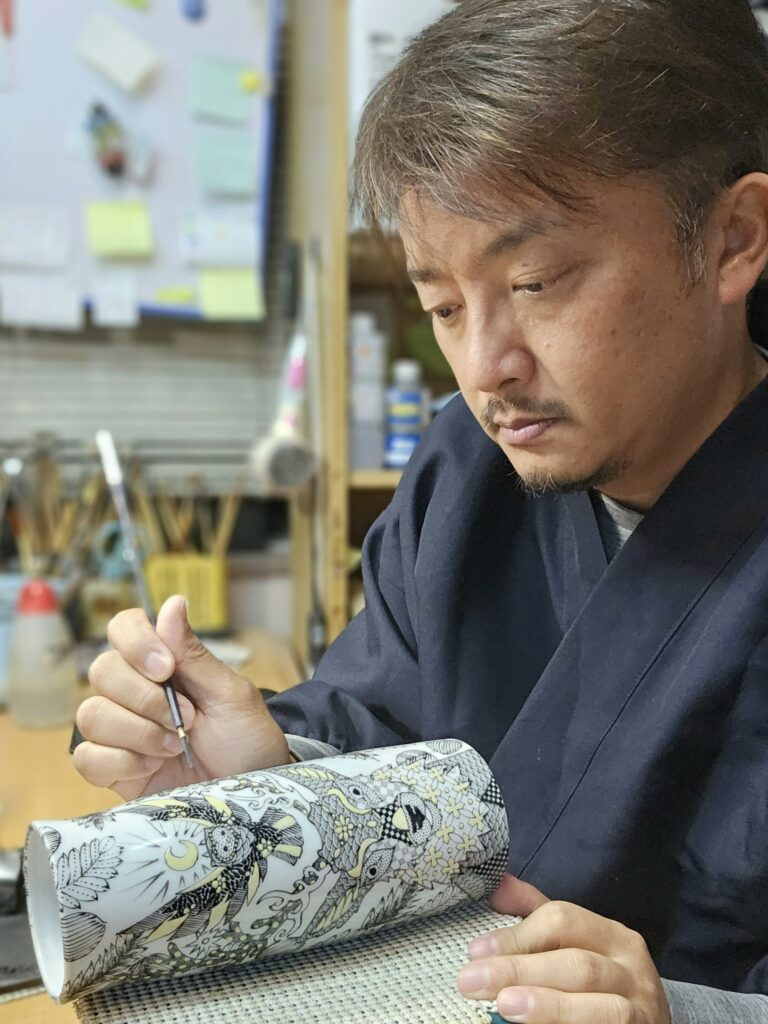
Kutani-yaki Artist
Kazuyoshi Kitamura
Born in Ishikawa Prefecture in 1974. After graduating from the Ishikawa Prefectural Kutani-yaki Technical Training Centre, he joined the Kutani Taketaka Kiln. He has won numerous awards and holds exhibitions throughout Japan. In addition to his conventional work, he has created many innovative pieces―such as trainers, stag beetles and false nails―based on traditional techniques. He also conveys the diverse appeal of Kutani-yaki through collaborations with toy and fashion manufacturers.